
Free tool · No sign-up
Car Accident Cost Calculator
Pick the parts that got hit, your car’s make and age, and your policy — and see two numbers that matter: the real repair bill, and what actually lands on you. Then find out how much of it clear evidence can protect.
Tick what’s damaged and set your details — the receipt updates live. Everything runs in your browser; nothing is sent anywhere.
The car & the damage
Your insurance & costs
Estimated repair bill
$2,530
Insurance usually covers this beyond your excess — if you claim.
Your out-of-pocket cost
$3,890
for one disputed accident you can’t prove
How is this calculated?
- Repair bill = the base cost of each damaged part, × a make factor (Japanese ≈0.9, American ≈1.0, European ≈1.35 — premium parts cost more) × a year factor (newer cars carry sensors, ADAS and complex panels, so they cost more to repair). Rough averages — a specialist quote will differ.
- Higher premium = your annual premium × the rise % × the years it lasts. Usually the biggest cost of an at-fault claim, and the one people forget.
- Hire car = days without your car × a typical $45/day. Injury, when ticked, adds a typical minor-injury out-of-pocket. Admin & time is a flat, unavoidable allowance.
- Excess / franchise: you pay it when you claim on your own policy. When you’re not at fault it’s often refunded once the other party is liable — but some policies still charge it, so set that toggle to match yours.
- “Clear evidence” assumes a disputed accident where you weren’t at fault and can prove it — so the other party’s insurer accepts liability and the recoverable costs come back. If you were genuinely at fault, evidence won’t reduce these.
- If the repair approaches ~60–70% of the car’s value, insurers usually write it off and pay the car’s value instead. All figures are approximate benchmarks (US) — adjust to your own policy and market. An estimate, not financial advice.
Why the number is bigger than the repair
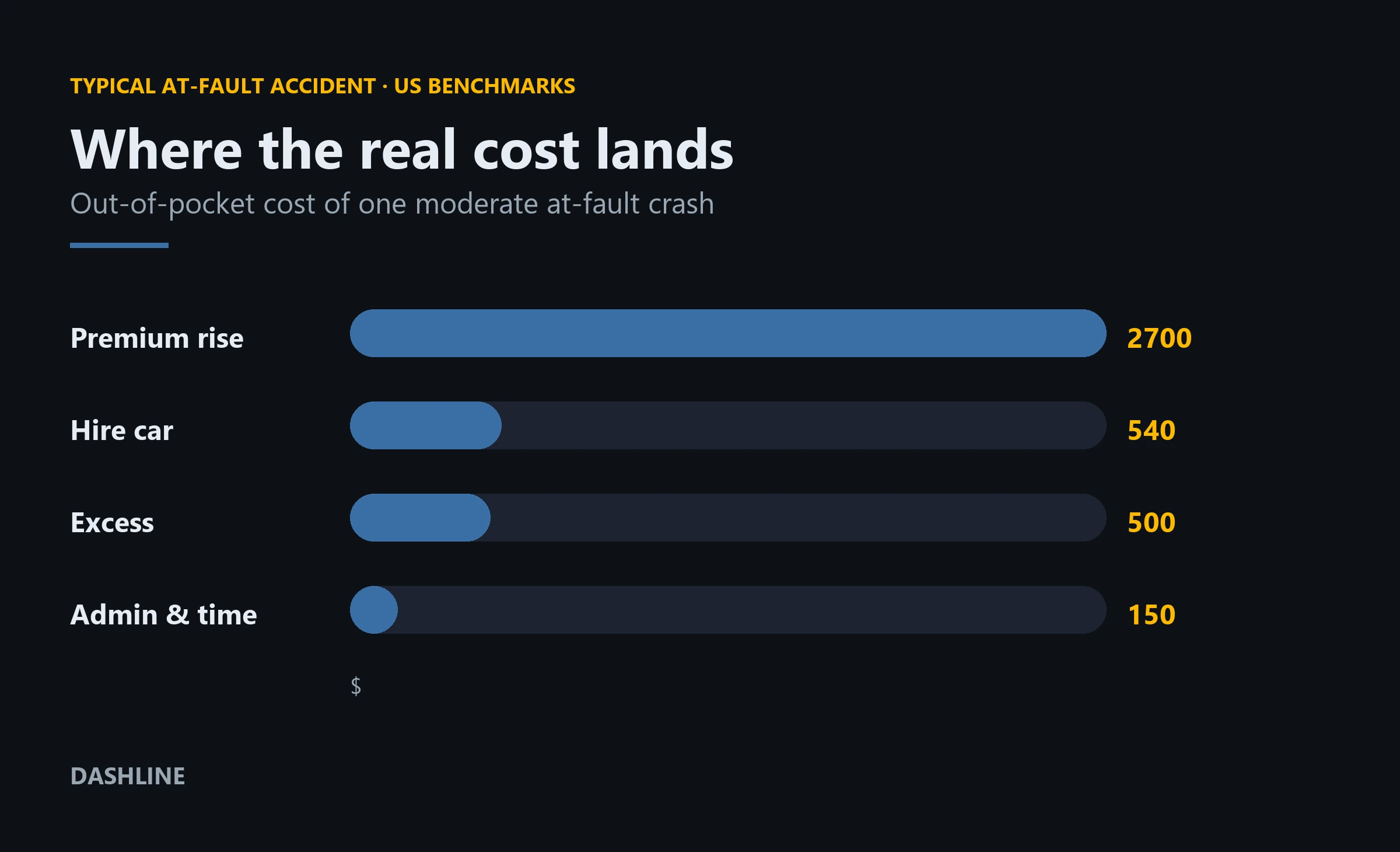
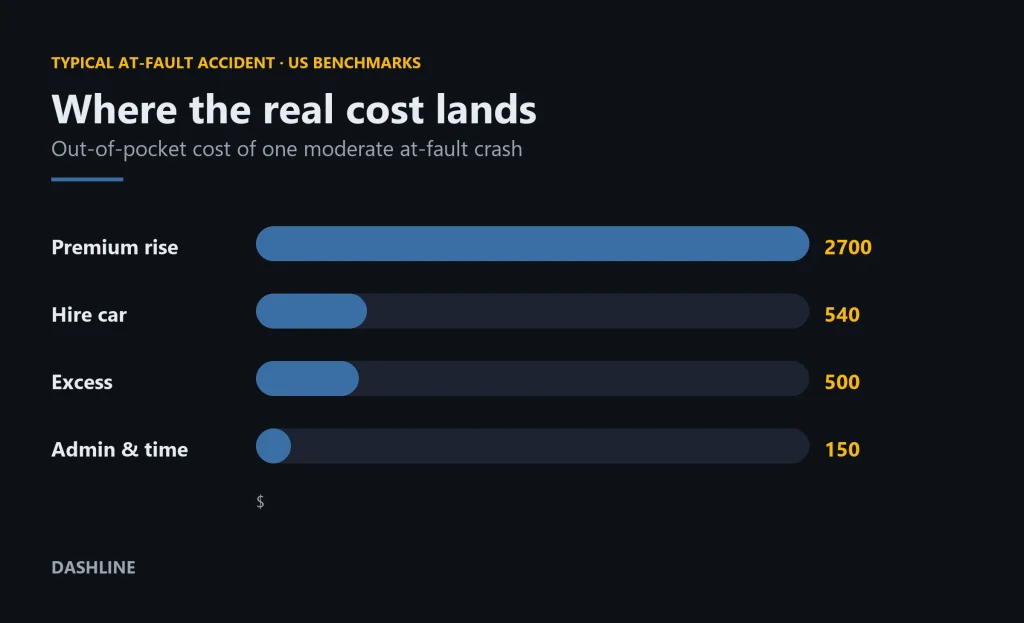
Where the real cost lands
Insurance usually pays the repair bill — but a string of other costs lands on you, and the premium increase quietly dwarfs the rest. These are typical US benchmarks; your figures drive the calculator above.
~$5,700
Typical collision claim (vehicle damage) an insurer pays out.
~$24,000
Average bodily-injury liability claim when someone is hurt.
Honest by design
What’s behind the numbers
The calculator does simple, visible arithmetic on your inputs — no black box. The repair bill adds up the parts you tick, scaled for make and age; the biggest out-of-pocket line, the premium rise, is just your premium multiplied by the increase and the years it sticks around. Everything is an estimate to sanity-check against a real quote and your own policy.
The “clear evidence” column is the honest part. A dash cam cannot prevent a crash and won’t help if you were at fault. What it can do is settle a disputed accident quickly — so a not-at-fault claim isn’t wrongly logged against you, your premium doesn’t climb, and the recoverable costs come back from the other side. Note that some policies still charge the franchise even when you’re not at fault — the toggle lets you model that. See also our insurance savings calculator and what to do after a car accident.
Use this tool anywhere
Cite or embed the calculator
Free to reference and free to embed. If it helped, a link back keeps it free and up to date for everyone.
Cite this page
Dashline — Car Accident Cost Calculator. https://dashlinecameras.com/car-accident-cost-calculator/Questions
Accident costs, answered
How much does a car accident really cost?
Far more than the repair. Insurance usually covers vehicle damage, but you still pay the excess, then years of higher premiums after an at-fault claim, plus a hire car, any injury costs and your own time. A moderate at-fault accident often costs a driver a few thousand out of pocket once the premium rise is counted — which is what this calculator estimates from your own figures.
How do you estimate the repair bill?
You tick which parts were damaged — bumper, bodywork, wheels and suspension, lights and sensors, windscreen, engine or airbags — and each carries a typical base cost. That total is then scaled by where the car is built (European premium parts cost more, Japanese less) and its age (newer cars pack sensors, ADAS and complex panels that cost more to fix). It’s a ballpark, not a garage quote.
Will I still pay the excess if I’m not at fault?
It depends on your policy. When the other party is clearly liable, many insurers refund or waive your excess — but some charge the franchise up front and make you reclaim it, and you don’t always get it all back. The “excess if you’re not at fault” toggle lets you model either case, which is exactly where clear evidence speeds things up.
Does a dash cam lower the cost of an accident?
Not if you caused it — a camera can’t prevent a crash or reduce your own liability. Where it helps is a disputed accident you didn’t cause: clear footage can stop a not-at-fault claim being wrongly recorded against you, which protects your premium and helps you recover costs from the other party. That’s the “clear evidence” column in the tool.
Are these figures accurate for my country?
They’re typical benchmarks, so treat them as a starting point. Part prices, excess/franchise rules, premium behaviour and hire-car rates vary by market and insurer — switch the currency and adjust every slider to match your own car and policy for a realistic estimate.
Is my data saved or sent anywhere?
No. The whole calculator runs in your browser. Nothing you enter is uploaded, stored or shared.
Sources
Insurance Information Institute — auto insurance facts & claim costs · NerdWallet — car insurance rates after an accident · Bankrate — how much a car accident raises insurance · Forbes Advisor — average car insurance cost · NHTSA — the economic impact of motor-vehicle crashes
Built by Dashline — a subscription-free 4K dash cam that records the evidence, so a disputed accident doesn’t become your word against theirs.

Leave a Reply