
Data desk • Updated 2026
Dash Cam Statistics 2026
How many drivers actually record their trips, how fast the market is growing, what insurers really offer, and where dash cams change safety outcomes — every figure below is sourced and free to cite.
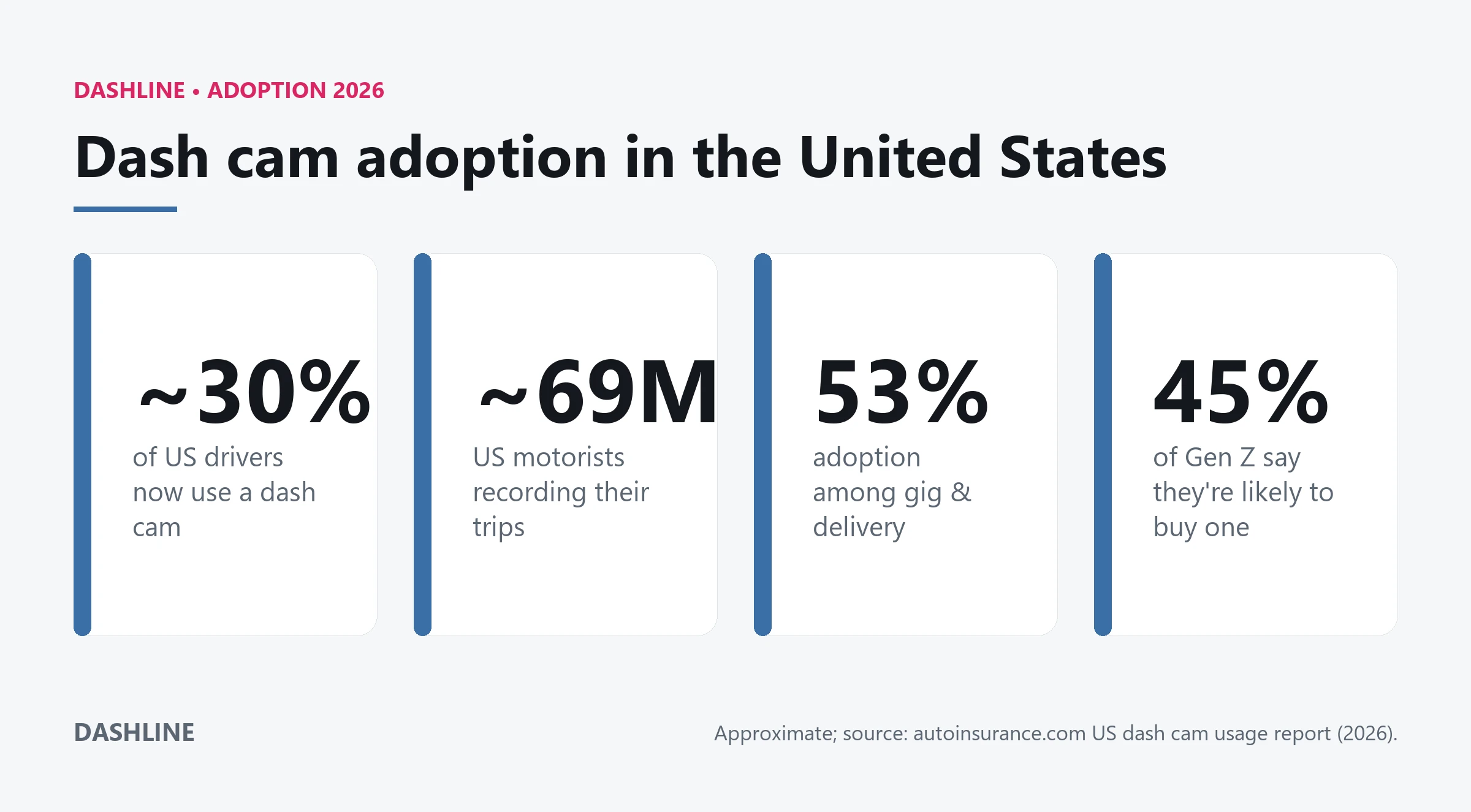
~30%
of US drivers use a dash cam
~69M
US motorists recording
$12.9B
global market by 2034
75%+
use footage for claims
The numbers worth quoting
Five takeaways for 2026
- Adoption has gone mainstream. Around 30% of US drivers — roughly 69 million people — now use a dash cam. — autoinsurance.com
- Gig workers lead. Adoption reaches ~53% among gig and delivery drivers; ~45% of Gen Z say they’re likely to buy. — autoinsurance.com
- The market keeps compounding. The global dashboard-camera market is projected to near $12.9B by 2034 (~11.3% CAGR). — IMARC Group
- Insurance perks are still thin. Direct discounts for simply owning a dash cam are rare; fleets save more by sharing footage. — insurance.com
- It changes safety outcomes. Fleets using AI cameras have reported large crash-rate reductions; most drivers use footage for claims. — Geotab
01 • Adoption & demographics
Who’s recording — and who isn’t
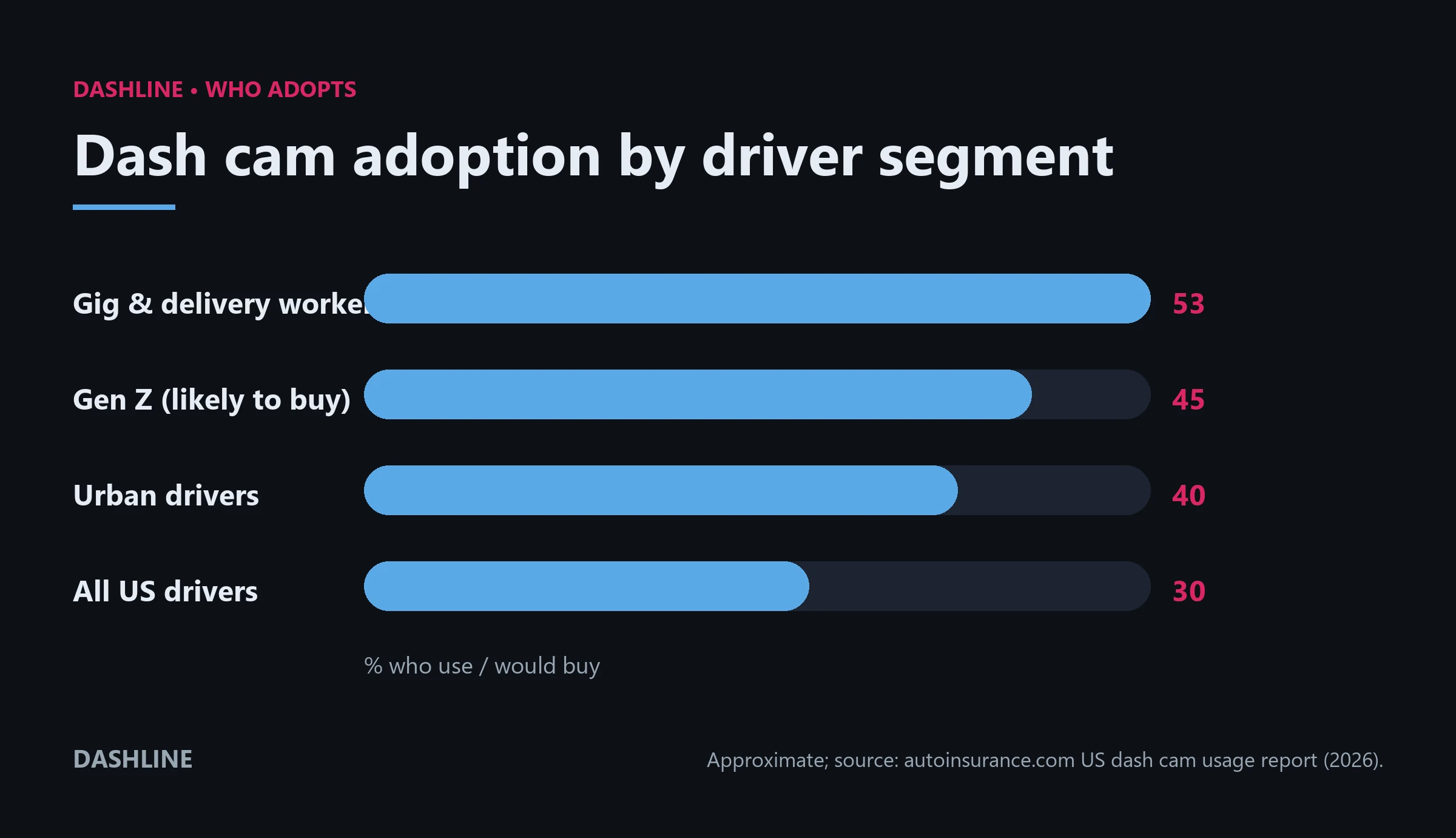
Dash cams have crossed from enthusiast gear to everyday kit. About 30% of US drivers now run one, an estimated 69 million motorists. Adoption is highest where the financial risk is highest: gig and delivery drivers (~53%) and younger, urban drivers.
Adoption by segment
Risk drives adoption
The drivers most exposed to disputes — rideshare, delivery, and dense-city commuters — adopt fastest. Low-mileage and rural drivers are least likely to record.
02 • Market size & growth
A market still compounding
Hardware keeps getting better and cheaper, and demand keeps widening. Analysts project steady double-digit growth through the early 2030s.
03 • Insurance & cost
The insurance reality
This is where expectations and reality diverge. In the US, direct discounts for simply owning a dash cam remain rare — Branch is a notable exception. The bigger savings are on the fleet side, where insurers reward sharing video and telematics data.
Want the honest version for personal policies? See our guide on whether a dash cam lowers your car insurance.
04 • Safety, accidents & fraud
Where footage changes outcomes
Beyond peace of mind, recorded footage shows up in measurable safety and claims data — especially in fleets that pair cameras with driver coaching.
up to ~73%
crash-rate reduction reported by fleets using AI cameras over ~30 months
Source: Geotab / industry
~30%
reduction in preventable accidents reported in year one of AI video telematics
Source: industry reports
Footage is also a recognised defence against staged “crash-for-cash” fraud. Just remember the legal side varies — see are dash cams legal.
The data, in one place
Dash cam statistics 2026: summary table
Every figure on this page in one sourced table. Quote any row — a link back to this page is all we ask.
| Metric | Figure | Period | Source |
|---|---|---|---|
| US dash cam adoption | ~30% of drivers (~69M) | 2026 | autoinsurance.com |
| Gig / delivery worker adoption | ~53% | 2026 | autoinsurance.com |
| Gen Z likely to buy | ~45% | 2026 | autoinsurance.com |
| Urban driver adoption | ~40% | 2026 | autoinsurance.com |
| Global market size (projected) | ~$12.9B by 2034 | 2026–2034 | IMARC Group |
| Global market CAGR | ~11.3% | 2026–2034 | IMARC Group |
| North America market | $1.31B → $2.18B | 2026–2031 | Mordor Intelligence |
| Consumer insurance discount | Rare (Branch a notable exception) | 2026 | insurance.com |
| Fleet savings for sharing video | ~5–20% | 2026 | Geotab |
| Fleet crash-rate reduction (AI cams) | up to ~73% over ~30 mo | 2026 | Geotab / industry |
| Drivers using footage for claims | 75%+ | 2026 | industry reports |
Methodology & sources
How this was compiled
Figures are aggregated from third-party industry reports and public research, rounded for readability, and reflect the latest available data as of 2026. They are estimates, not guarantees — follow each source for full methodology.
- autoinsurance.com — US dash cam usage report
- IMARC Group — dashboard camera market
- Mordor Intelligence — North America dashboard camera market
- insurance.com — dash cam & insurance
- Geotab — do dash cams lower insurance
- wifitalents — dashcam industry data
Cite this page
Dashline Cameras (2026). Dash Cam Statistics 2026: Adoption, Market, Insurance & Safety Data. dashlinecameras.com/dash-cam-statistics-2026/
FAQ
Dash cam statistics: quick answers
How many people use a dash cam in 2026?
About 30% of US drivers — roughly 69 million motorists — now use a dash cam, according to autoinsurance.com’s usage report. Adoption is highest among gig and delivery drivers (~53%).
How big is the dash cam market?
The global dashboard-camera market is projected to approach $12.9 billion by 2034, growing at roughly 11.3% per year, per IMARC Group. North America alone is forecast to rise from about $1.31B in 2026 to $2.18B by 2031 (Mordor Intelligence).
Do dash cams lower car insurance?
Rarely on personal policies. In the US, direct discounts for simply owning a dash cam are uncommon (Branch is a notable exception). Fleets see more value, with ~5–20% savings reported for sharing video and telematics data.
Do dash cams actually improve safety?
In fleets that pair cameras with driver coaching, large crash-rate reductions have been reported (up to ~73% over ~30 months for AI cameras), and most drivers use footage to support claims. Footage is also a recognised defence against staged crash-for-cash fraud.
Can I reuse these statistics?
Yes. Every figure is sourced and free to cite — please link back to this page and check the original source for full methodology.
Compiled by Dashline
This data desk is maintained by the team at Dashline Cameras, makers of a premium 4K front-and-rear dash cam. We track this category because we build for it — honestly, specs and limits included.
New to dash cams? Start with how to choose a dash cam.

Leave a Reply