
Field of view · Coverage
How much does a dash cam actually see?
A wide lens looks impressive on the box. What matters is how much road it really records — and where the detail lands. Here is the honest picture, from above.
The marketing trick
The number on the box isn’t the number on the road
Almost every dash cam quotes a big diagonal angle — corner to corner — because it is the largest number a lens can claim. But footage is recorded left to right. The horizontal view, the part that actually captures the road and the cars around you, is always smaller.
A “170°” lens typically sees closer to 130–140° across. Going wider also spreads the same pixels over more scene, so objects at the edges — including licence plates — get smaller and softer, and straight lines start to bend. Wider is not automatically better.
Diagonal vs. horizontal
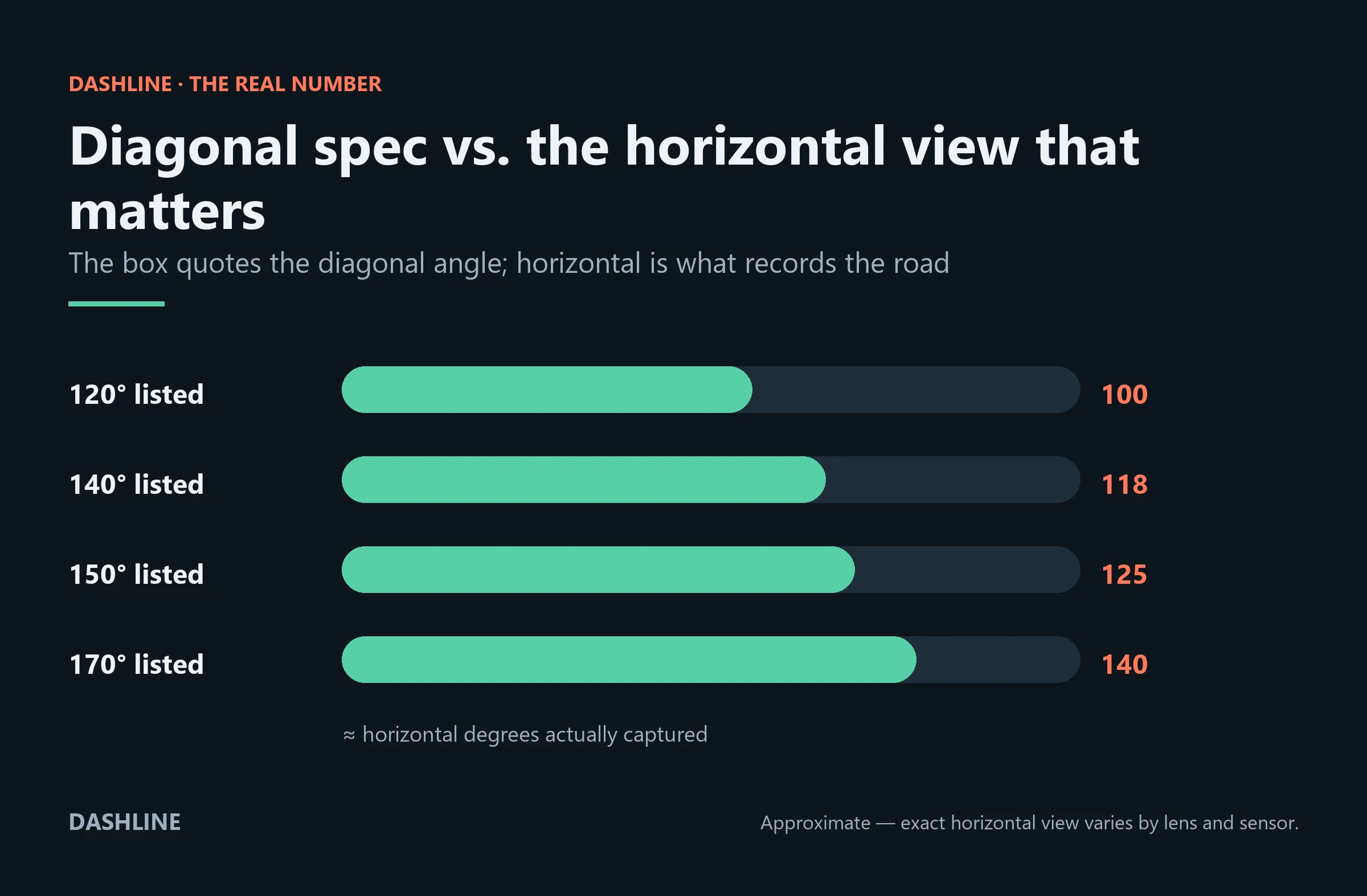
170° diagonal ≈ 130–140° horizontal
150° diagonal ≈ 120–125° horizontal
120° diagonal ≈ 95–100° horizontal
Approximate — the exact figure depends on the lens and sensor.
The 30-second answer
How much does a dash cam see?
A single front camera covers the road ahead and a chunk of the lanes either side — roughly a 130–150° horizontal view from a typical “150–170°” lens. It does not see behind you, and detail fades toward the edges. Add a rear camera and you cover what is following you too.
The sweet spot for evidence is a wide-but-not-extreme front lens (clear context without heavy distortion) paired with a slightly tighter rear lens (sharper plates of the car behind). That is exactly how Dashline is set up: a wide 170° front and a focused 140° rear.
What a front + rear dash cam covers
Seen from above: a wide field ahead for context at junctions and across lanes, and a tighter, sharper field behind for the car following you.
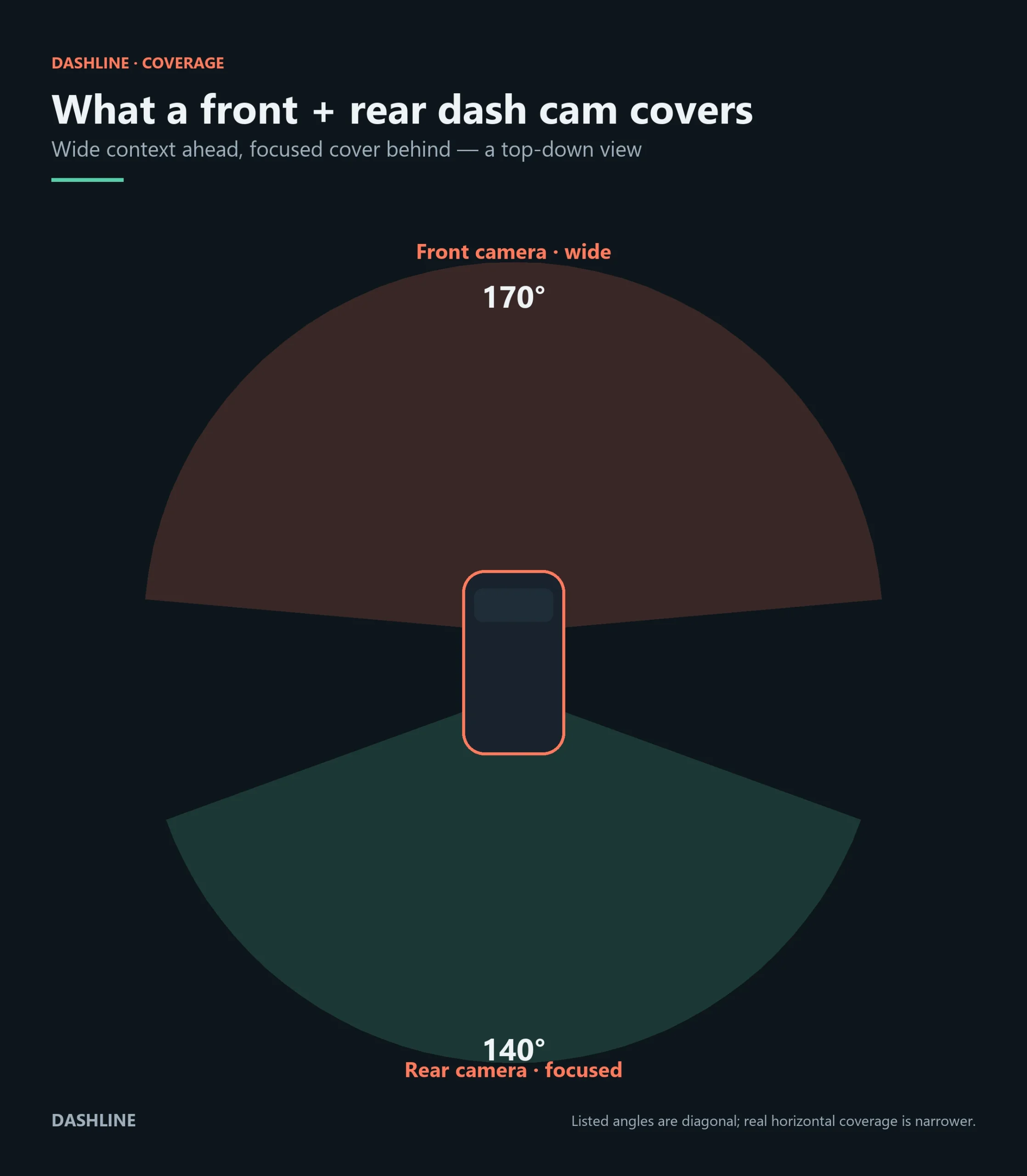
One camera can only watch one direction at a time. If what happens behind you matters — rear-end collisions, tailgating, parking knocks — you need the second channel. See our guide to the best front and rear dash cam.
Pick an angle, see the trade-off
Every extra degree of width costs a little detail. Tap a lens angle to see what you gain — and what you give up.
Narrow · ~100° horizontal
Tight, detailed, almost no distortion
The lane ahead and the vehicle directly in front. Lines stay straight; plates of the car ahead are at their sharpest.
You lose the sides — a car cutting in from an adjacent lane or a cyclist at a junction can fall outside the frame.
Sweet spot · ~120–125° horizontal
Wide enough for context, sharp enough for evidence
Your lane plus the lanes either side and most of a junction, while keeping detail high and distortion low. The usual recommendation for a front camera.
Very little. A touch less edge coverage than an extreme wide lens — rarely the part that matters.
Wide · ~130–140° horizontal
Maximum context, softer edges
The widest scene — multiple lanes, pavements and side approaches. Best when surrounding context matters as much as the car ahead.
The same pixels stretch over more scene, so edges are softer and barrel (“fisheye”) distortion is more visible. Plates near the edges read less reliably.
Angle by angle, what it really means
Translate the spec on the box into the view you actually get on the road.
| Listed angle (diagonal) | Real horizontal view | Best for | Watch out for |
|---|---|---|---|
| 120° | ~95–100° | Sharpest plates of the car directly ahead | Misses side approaches and adjacent lanes |
| 140° | ~115–120° | A balanced rear camera; tight front | Slightly narrow for a busy junction up front |
| 150° | ~120–125° | The front-camera sweet spot — context + detail | Minor edge distortion only |
| 170° | ~130–140° | Maximum surrounding context | Softer, more curved edges; edge plates harder to read |
Want the exact numbers for a specific lens? The dash cam field of view calculator turns any listed angle into its real horizontal view and the coverage width you get at a set distance.
The gap between the spec and the view
The bigger the listed (diagonal) number, the bigger the gap to the horizontal view that actually records the road.
Where the detail lands
A wide view is not an even view
Field of view tells you how much the camera captures. It says nothing about how well each part is captured. A lens packs the most pixels into the centre, so the car directly ahead is always the sharpest thing in the frame.
Toward the edges, the same scene is spread thinner. That is why a wider angle and a higher resolution work together: the angle decides what is in shot, the sensor decides whether the edges are still readable. Coverage and clarity are two different questions.
What no field of view can promise
A camera is evidence, not a force field. Here is what coverage genuinely cannot do.
Edges lose detail
Wider angles stretch the same pixels over more scene. A plate that is crisp in the centre can be unreadable at the frame edge — especially at speed or at night.
It can’t see through itself
One camera watches one direction. Without a rear unit, nothing behind you is recorded — rear-end hits and tailgaters included. Blind spots stay blind.
Plates are still conditional
Even dead-centre, readability depends on distance, speed, light and resolution. Coverage gets the car in frame; it does not guarantee a legible plate. More on reading plates at night.
Wider distorts shapes
Beyond about 150° horizontal, barrel distortion bends straight lines and stretches cars near the edges — which can make footage less convincing as evidence, not more.
Cover what matters to you
Front, or front + rear?
Dashline records a wide 170° front and a focused 140° rear in true 4K up front. Start with the road ahead, or cover both directions from day one.
Choose your setup
One camera. Three levels of protection.
From everyday recording to full 24/7 surveillance — pick the package that matches how you drive.
Standard
Package contents
- Front camera
- Car connection cable
- Magnetic sticker
Most popular
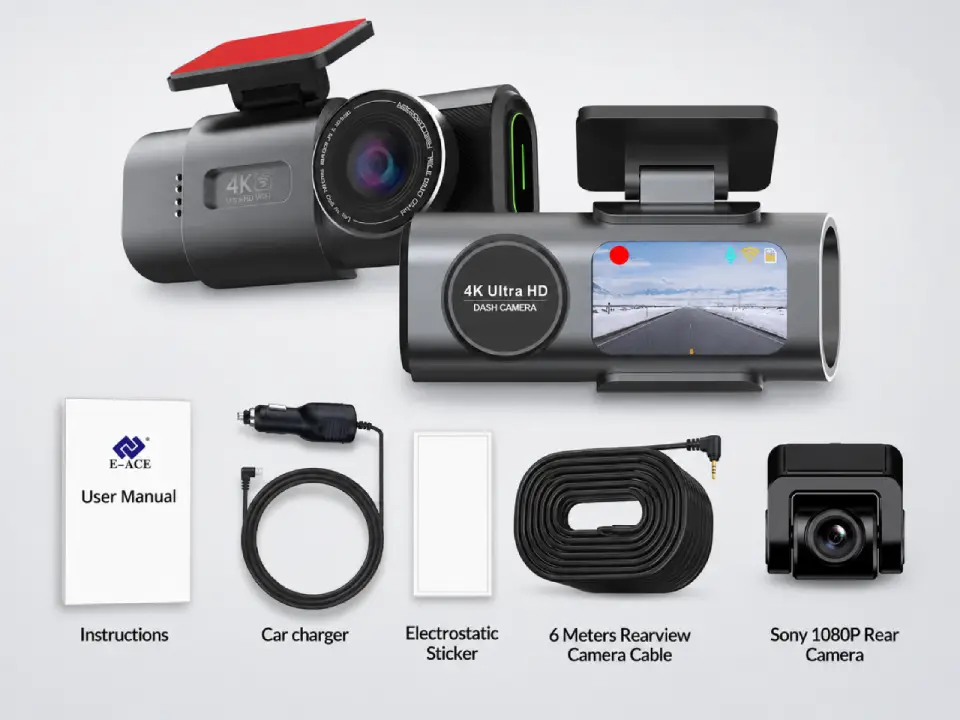
Dual Cameras
Package contents
- Everything in Standard
- Sony rear camera
- 6-meter connection cable
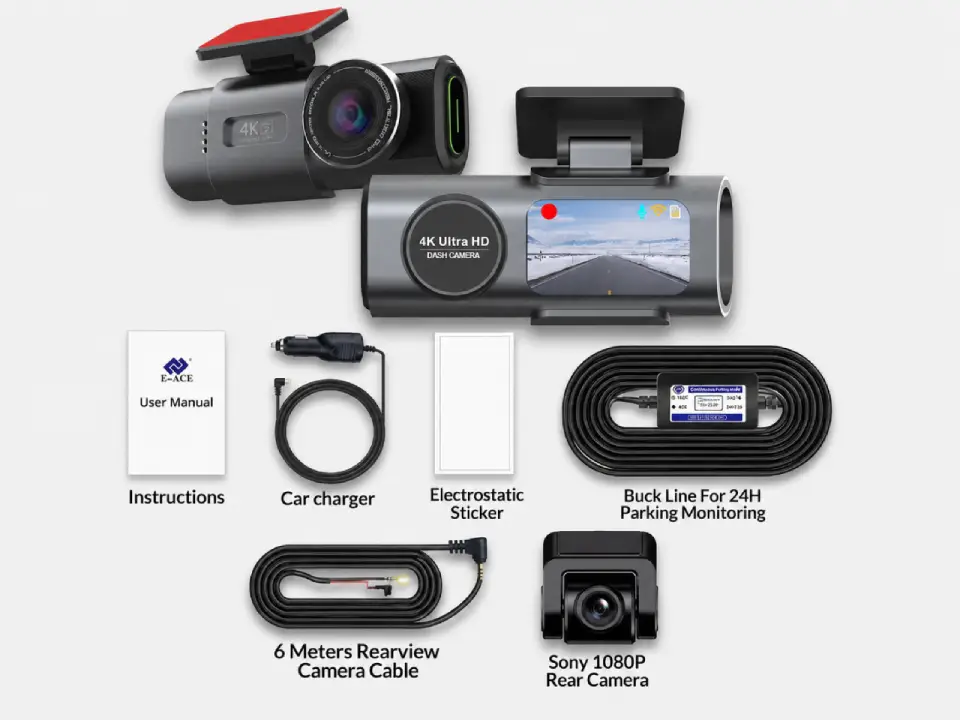
Full Protection
Package contents
- Everything in Dual Cameras
- 24h-compatible battery
- Live view from parked car
Free Shipping
5–10 days across Europe
Secure Payment
Apple Pay · PayPal · Stripe
2-Year Warranty
Full hardware coverage
30-Day Return
No questions asked
Field of view: common questions
What field of view does a dash cam need?
For a front camera, a horizontal view of roughly 130–150° (often listed as 150–170° diagonal) is the sweet spot — wide enough to cover your lane and the lanes either side, without the heavy distortion and detail loss of an extreme wide lens.
Is a higher viewing angle always better?
No. A wider angle captures more scene, but spreads the same pixels over it, so edges get softer and licence plates near the frame edge are harder to read. Past about 150° horizontal, distortion can make footage less useful as evidence.
Why is the angle on the box bigger than what I see?
Manufacturers usually quote the diagonal field of view (corner to corner), the largest number a lens can claim. The horizontal view that records the road is smaller — a 170° diagonal lens typically sees about 130–140° across.
Does a dash cam record everything around the car?
No. A single front camera sees only ahead and to the sides, not behind you or directly to your left and right beyond its cone. A rear camera adds coverage of what is following you; together they cover the two directions that matter most.
What field of view does the Dashline have?
Dashline lists a wide 170° front lens and a focused 140° rear lens. The front is set up for context across lanes and junctions; the tighter rear concentrates detail on the vehicle behind you.
Does a wider angle help read licence plates?
Usually the opposite. Plates read best when they are near the centre of the frame and reasonably close. A wider lens pushes more of the scene toward the soft edges, so for plate detail a slightly tighter angle plus good resolution often wins.
Front and rear, or one wide camera?
One camera, however wide, still only faces one way. If rear-end collisions, tailgating or parking knocks matter to you, a two-channel front + rear system covers far more than a single ultra-wide front lens.
What is barrel distortion?
The curved, “fisheye” look of wide-angle footage — straight lines bow outward and objects near the edges stretch. It increases with the lens angle and is one reason extreme-wide dash cams are not always the best choice for clear evidence.
Cover the road, not just the brochure
True 4K up front, a focused rear channel, GPS and parking mode — no subscription. Free EU shipping, 2-year warranty, 30-day returns.
Leave a Reply