
After dark · your car is alone
Can a Dash Cam Catch Someone Breaking Into Your Car?
Yes — if it’s still recording while you’re gone. Here’s what a parking-mode dash cam really sees when someone tries your doors, and the blind spots no camera can fix.
The problem
Most break-ins happen where nobody’s watching
A car spends almost its whole life parked — outside a house, in a lot, on a quiet street — with no one in it. That is exactly when a window gets popped for the bag on the seat, a badge gets prised off the bonnet, or a row of door handles gets tried in the dark.
By the time you’re back, the person is long gone and it’s your word against an empty parking space. A camera that keeps recording while you’re away is what turns that blank into a timestamped clip.
A parked car can’t call for help.
A dash cam that’s still awake is the only witness you leave behind.
The 30-second answer
Can it catch a thief? Honestly — often, not always
A front-and-rear dash cam left recording in parking mode is a genuinely useful witness for a break-in — but only when it’s powered, pointed the right way and set up to lock the moment it matters. Here’s the honest shape of it.
Needs power
Parking mode only runs if the camera still has power. The 12 V socket usually dies with the ignition, so break-in capture needs the hardwire kit.
Impact + motion
A G-sensor locks a clip the instant glass breaks; motion detection wakes the camera as someone steps toward the car.
A witness, not a guard
It records evidence for the police and your insurer. It will not physically stop someone who is determined to get in.
Front + rear arcs
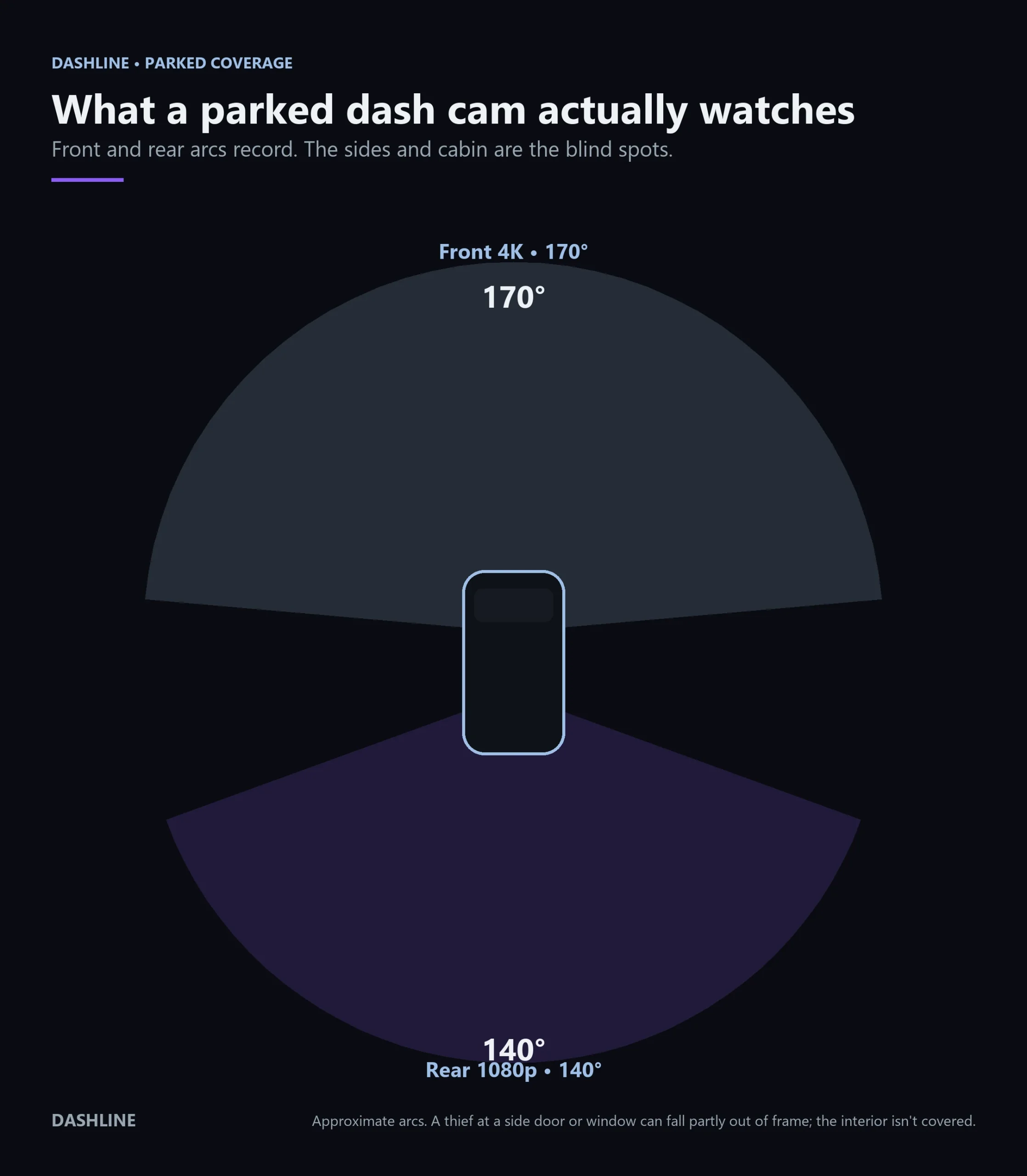
It watches the road ahead and behind the car. Side doors, the cabin and a covered plate are the honest blind spots.
The capture window
The six seconds that actually matter
A break-in is fast. What decides whether you get a usable clip isn’t luck — it’s whether the camera was already buffering and whether it locked the moment of impact.
Approach
Motion detection wakes the camera as someone steps into the front or rear arc. With buffered recording on, it’s already saving the seconds before anything happens.
Impact
The G-sensor feels the hit — a smashed window, a yanked handle, a kicked panel — and locks the current clip so the loop can never overwrite it.
Getaway
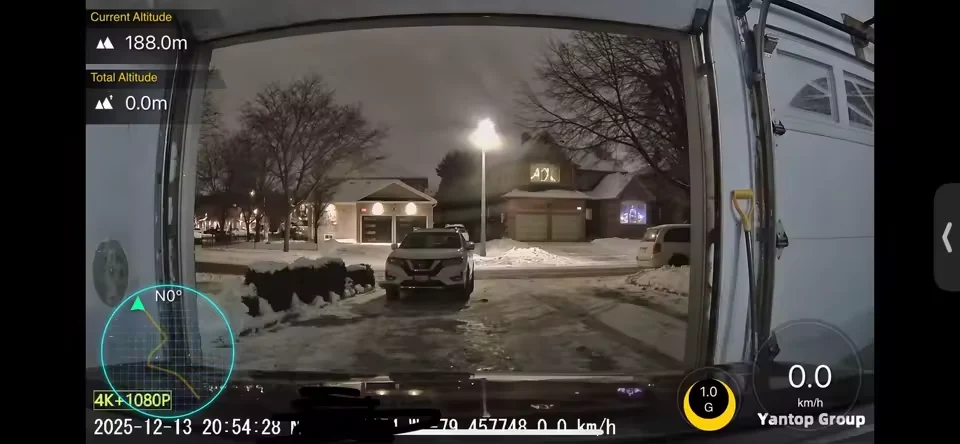
It keeps rolling as they leave, catching the direction they run and, when the lighting and angle allow, a face or a plate on the way out.
Buffered pre-record + impact lock is why the clip survives. Plain motion mode alone can miss the first second — and it fills the card fast on a busy street, burying the one event you needed.
What it watches
It guards the arcs — not the whole car
A front-and-rear setup watches two wide cones: ahead of the bonnet and behind the boot. Someone approaching from those directions is on camera. A thief working a side door, reaching through a window, or crouched at the far wheel can sit in the gap between the cones — and the cabin isn’t covered, because the rear camera films back through the glass, not the seats.
Pick your scenario
Which break-in are you worried about?
The camera behaves differently for each. Tap a scenario for the honest version of what you’d actually get — and where it falls short.
Smash-and-grab
A window goes for a bag on the seat, often in seconds. Impact lock is the hero here: the G-sensor saves the clip the instant the glass breaks, usually with the approach already buffered. Keep valuables out of sight — the camera is evidence, not a force field.
Driveway or street at night
Someone tries handles down a row of parked cars. Motion detection wakes the camera as they enter the front or rear arc. Readability depends on your streetlight: a lit driveway gives a far stronger clip than a pitch-black kerb, where you’ll get movement more than a face.
Vandalism or keying
A scratched panel, a snapped mirror. If it happens inside the front or rear arc it’s caught; a key dragged along the far side may sit in the blind zone. Either way the timestamp and GPS log prove where and when for a claim.
The camera itself
A thief who spots the camera can take it — and because Dashline stores footage locally on the microSD, the clip leaves with it. Mount it high and discreetly behind the mirror, and treat parking capture as evidence you may get, not a guarantee you’ll keep.
If it was another vehicle that hit your parked car and drove off, that’s a parked hit-and-run — a related but different case.
The honest part
What a dash cam won’t do
The pages selling you a camera rarely say this out loud. A dash cam is a witness with real limits — knowing them is how you set yours up to actually help.
It doesn’t prevent theft
A small camera on the glass won’t stop someone who’s determined. Its job is to document what happened so you’re not left with nothing — a report, a claim, a description.
No power, no footage
Without a hardwire kit and a low-voltage cutoff, the camera sleeps when the engine’s off. Parking capture lives or dies on continuous power — and the cutoff protects your starter battery. Our free dash cam parking mode battery calculator estimates how many hours yours can record parked before the cutoff steps in.
The card can walk
Footage sits on the microSD inside the camera. If both are taken, so is the clip. Dashline stores locally and subscription-free — there’s no cloud copy to fall back on, so mount it discreetly.
Night is still physics
A readable face or plate needs some light. Under a good lamp you’ll often get it; on a black street, expect shapes and movement, not a mugshot. No dash cam beats the laws of light.
Dial it in
Settings that make the difference
Most owners never leave the defaults. These are the settings that decide whether a parked camera catches a break-in or just records an empty car park.
The Dashline 4K
Built to keep watch after you’ve gone
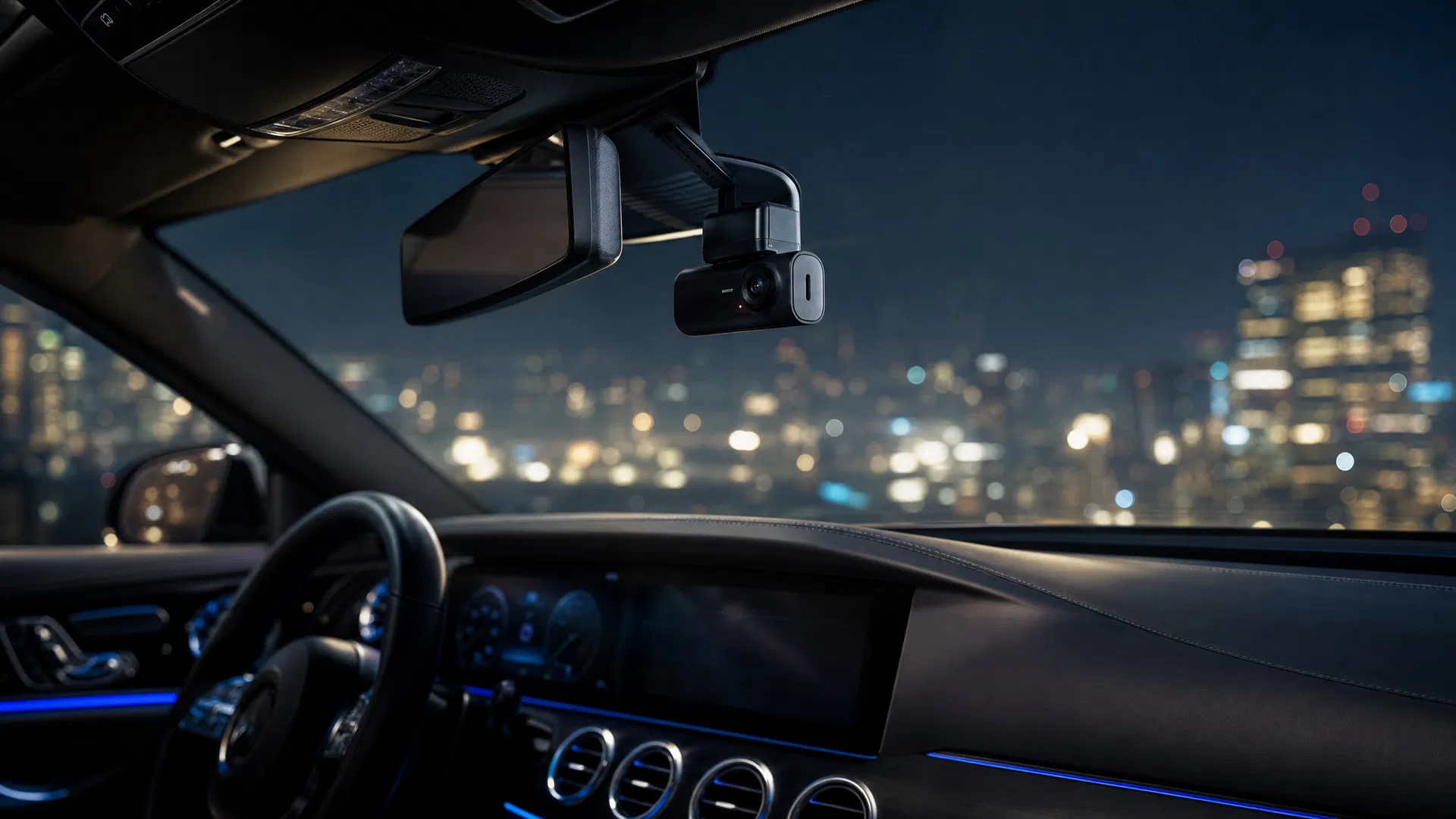
The Dashline 4K records in 4K up front with a wide 170° view, adds a rear channel for the arc behind the car, and — with the Full Protection hardwire kit — keeps a low-power watch over your parked car using impact and motion detection.
Storage is local and subscription-free: no monthly fee, but no cloud either, so keep the card in and the camera discreet. It’s a witness that never clocks off, and it’s honest about what it can and can’t see. Compare the front & rear system.
Choose your cover
Parking protection lives in Full Protection
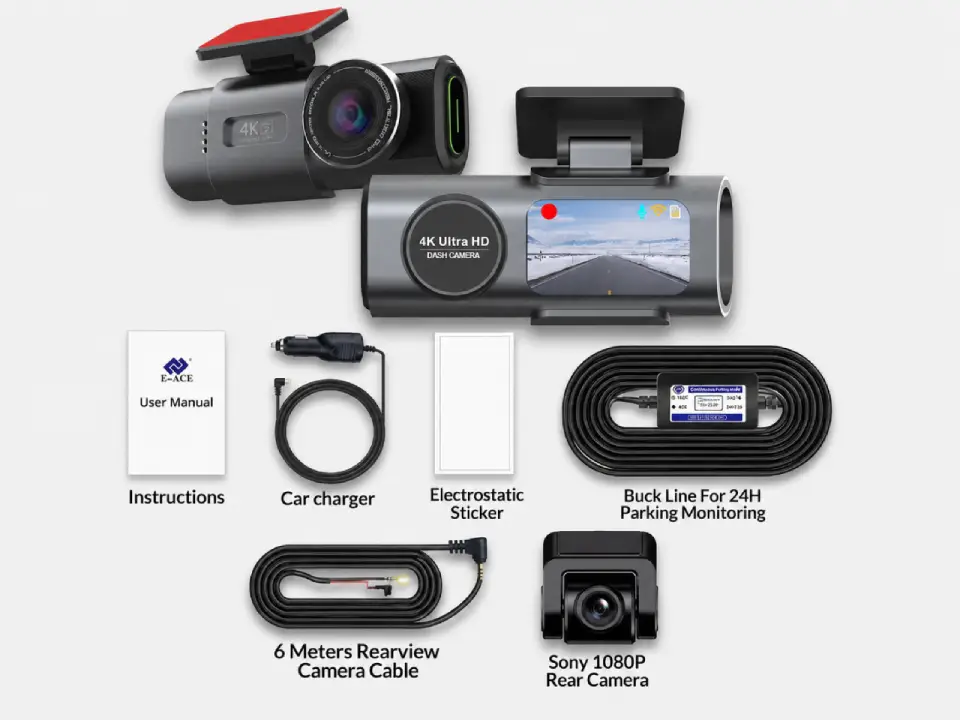
Standard covers the road ahead. Dual Cameras add the rear arc. Only Full Protection ships the 24-hour hardwire kit that keeps the camera awake over your parked car — the piece that makes break-in capture possible.
Choose your setup
One camera. Three levels of protection.
From everyday recording to full 24/7 surveillance — pick the package that matches how you drive.
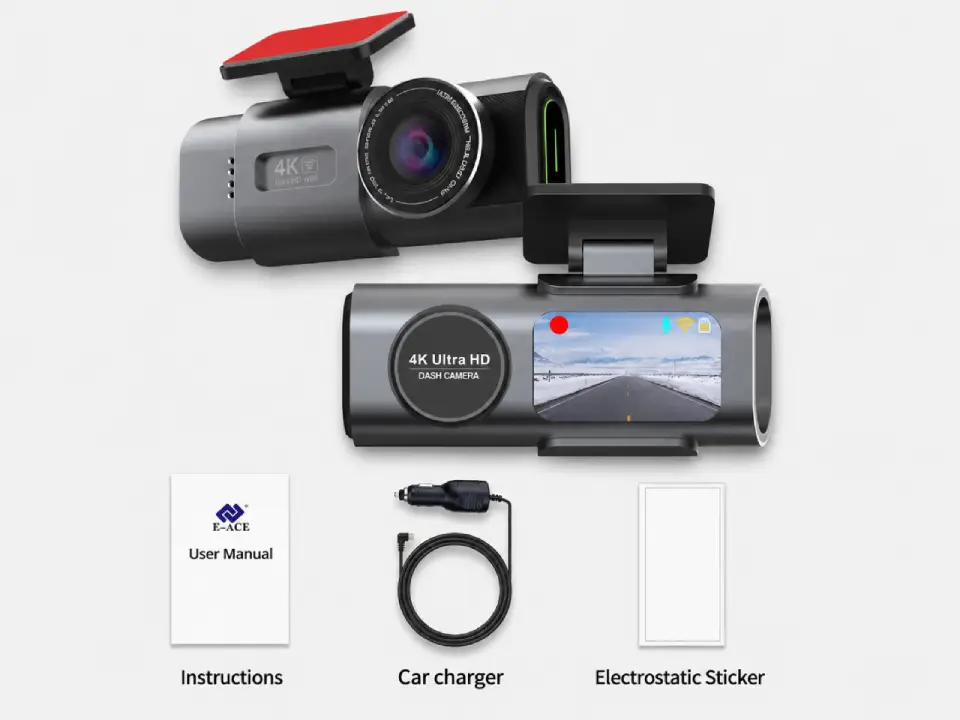
Standard
Package contents
- Front camera
- Car connection cable
- Magnetic sticker
Most popular
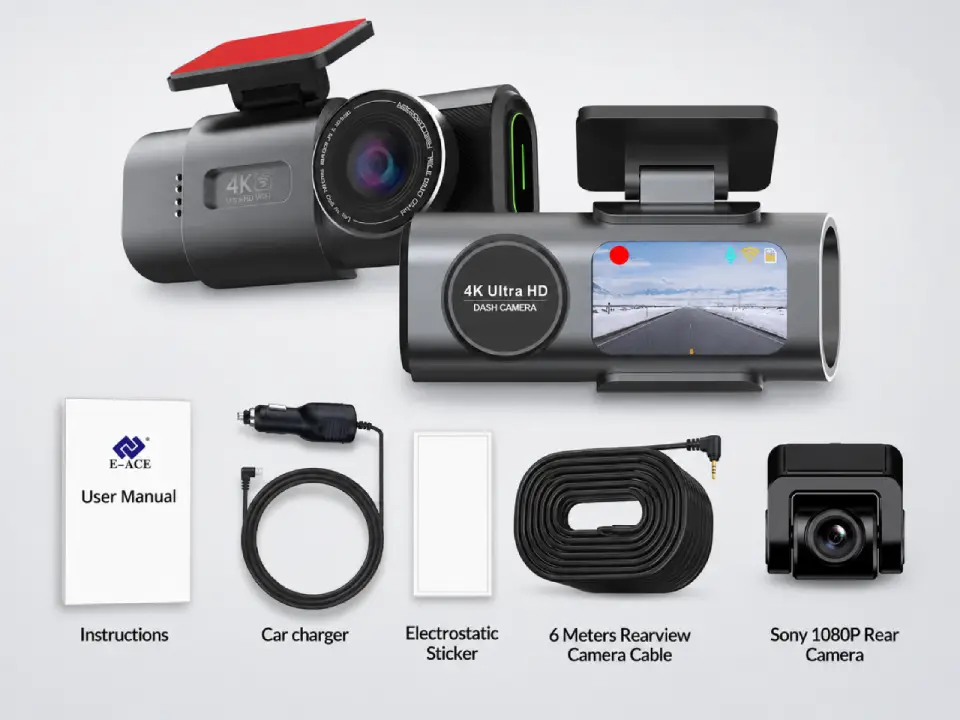
Dual Cameras
Package contents
- Everything in Standard
- Sony rear camera
- 6-meter connection cable
Full Protection
Package contents
- Everything in Dual Cameras
- 24h-compatible battery
- Live view from parked car
Free Shipping
5–10 days across Europe
Secure Payment
Apple Pay · PayPal · Stripe
2-Year Warranty
Full hardware coverage
30-Day Return
No questions asked
Questions
Dash cams & break-ins, answered
Can a dash cam record while my car is parked and locked?
Will a dash cam stop someone from breaking into my car?
Do I need to hardwire it to catch a break-in?
Can it catch someone stealing from inside the car?
What if the thief takes the dash cam or the SD card?
Will it read the thief’s face or number plate at night?
Does motion detection fill up the memory card?
Is a front-and-rear dash cam better for theft than front-only?
Cover the hours you’re not there
Give your car a witness for the hours it’s alone
- ◉ 4K front + rear arcs
- ◉ 24-hour parking mode
- ◉ No subscription, ever
Free shipping · 2-year warranty · 30-day returns

Leave a Reply