
Dashline Tools · Free calculator
Dash Cam Parking Mode Battery Calculator
Parking mode keeps recording while you’re away — but it runs off your car battery. Set three things below to estimate how long a dash cam can safely record before it reaches your battery’s safe reserve.
hours = (Ah × 12 V × usable%) ÷ (camera W + 0.5 W vehicle standby). Assumes a healthy battery at mild temperature with the engine off. Cold, an aging battery and your car’s own standby draw all shorten real runtime — treat the number as a ceiling, not a promise.Read your result
What the number actually means
Three ideas do all the work. Each one is worth quoting on its own.
÷ draw
Runtime is energy ÷ draw
Your usable battery energy divided by how many watts the camera pulls. Halve the draw and you roughly double the hours.
~1/3–1/2
You only spend a slice
A starter battery hates deep discharge. The calculator never assumes more than 20–50% is used — the rest is the reserve that still starts your car.
−20–50%
Cold shrinks the ceiling
A cold night can temporarily remove a fifth to half of a battery’s capacity, so winter runtime is well below the mild-weather estimate.
No magic
How the calculator works
It is one honest formula, shown in full so you can check it against your own numbers:
protected hours = ( capacityAh × 12 V × usable % ) ÷ ( camera W + 0.5 W standby )12 V nominal is the working voltage of a resting 12-volt battery. Usable % is the safe reserve you chose — the share of capacity you’re willing to spend before you risk a no-start. 0.5 W standby is a typical amount your parked car draws on its own (clock, alarm, control units) on top of the camera. Divide usable watt-hours by total watts and you get hours.
What it deliberately does not model: a tired or old battery, extreme heat or cold, a weak alternator that never fully recharges on short trips, or accessories left on. Real runtime lands below the estimate more often than above it, so read the result as a safe ceiling.
At a glance
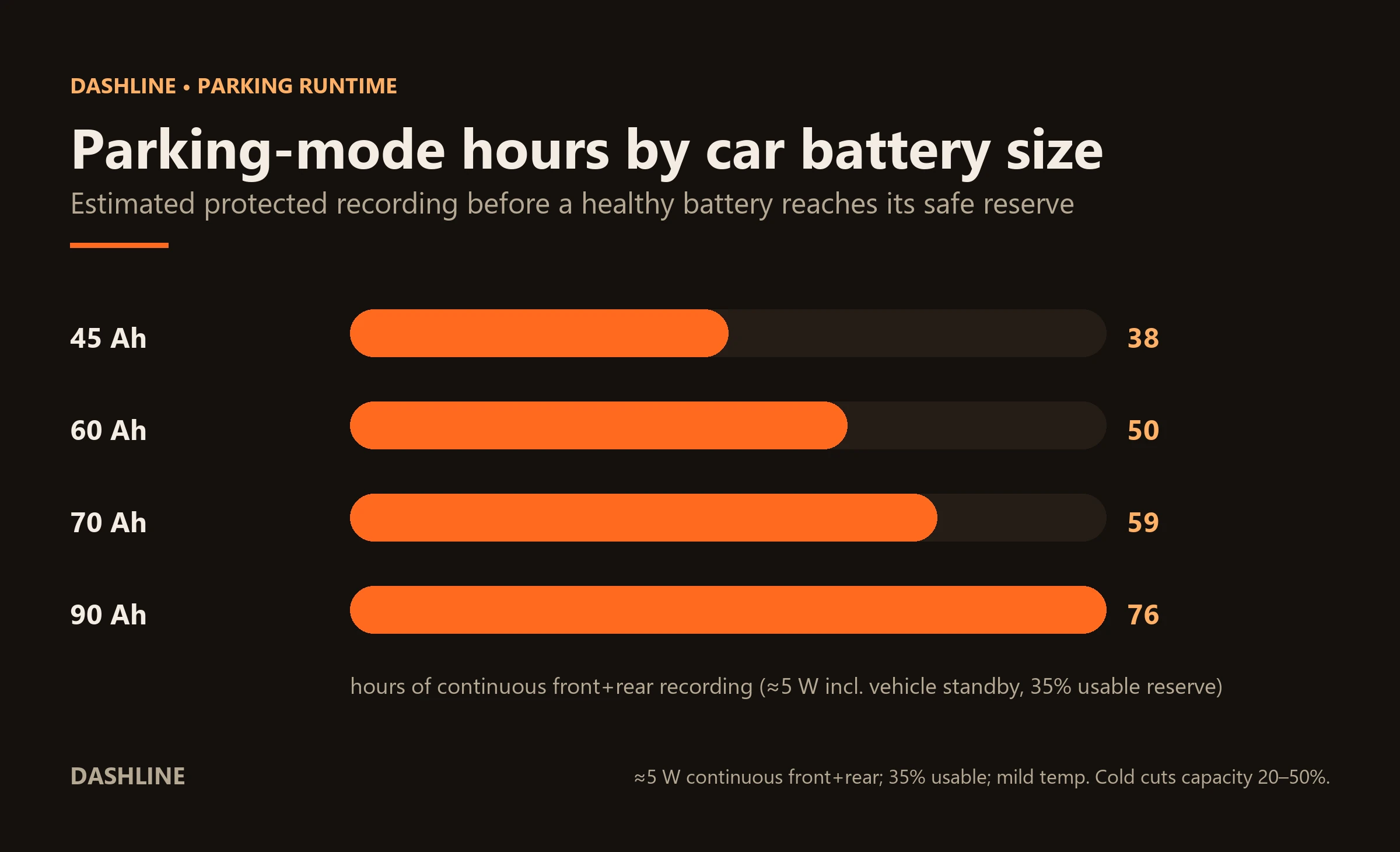
Hours by battery size
At a steady front+rear draw and a balanced reserve, capacity sets the ceiling. Bigger battery, more hours.
The data behind it
Numbers & sources
| Variable | Typical value | Notes & source |
|---|---|---|
| Time-lapse / buffered draw | ~2 W (front) | Image processor active only in bursts — the lowest-power recording mode. VIOFO |
| Continuous draw, front only | ~3 W | Full sensor + processor running the whole time. DashCamTalk |
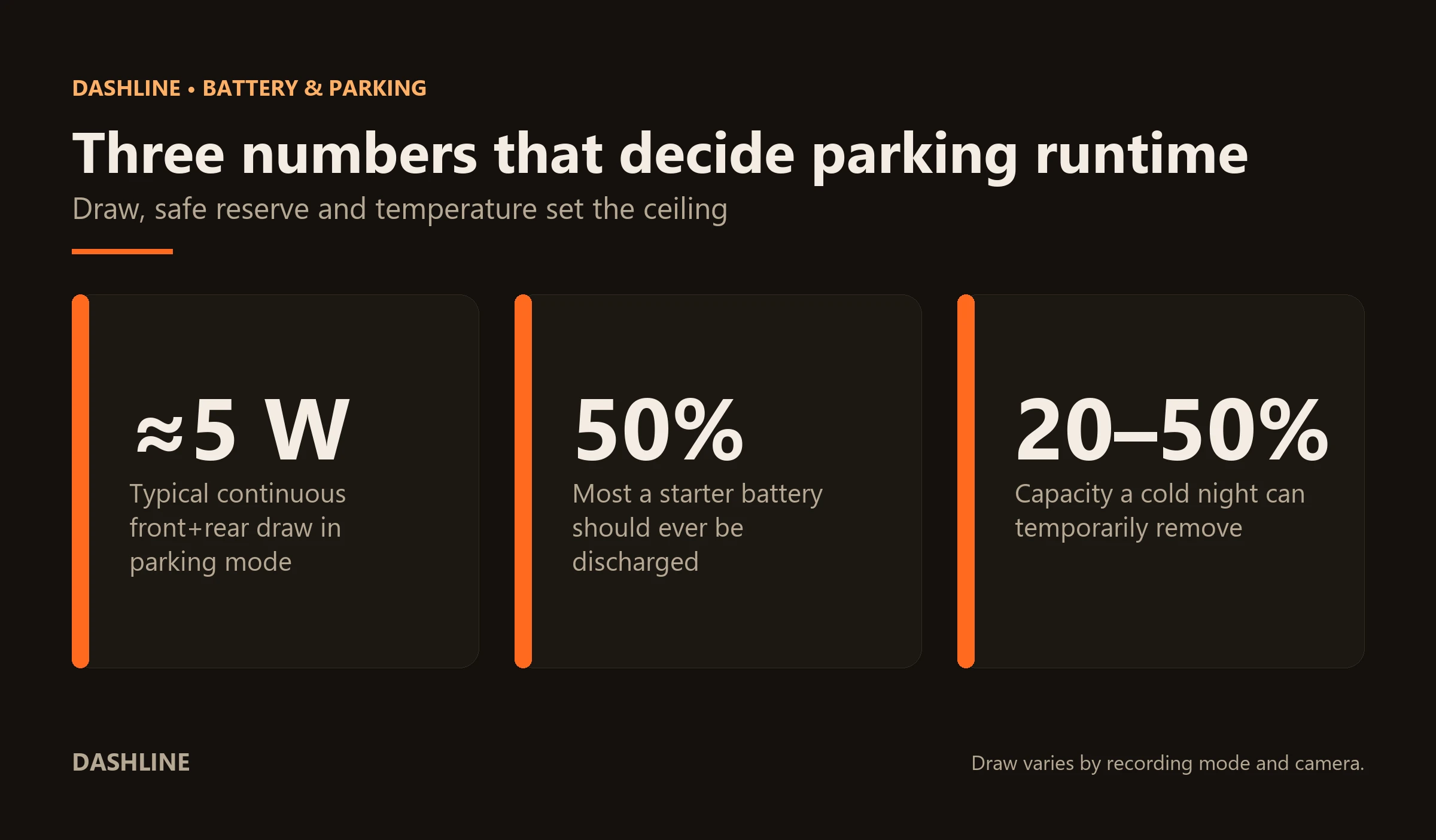
| Continuous draw, front + rear | ~4.5 W | Roughly 300 mA at 12 V (≈4 W) with a rear channel; ≈96 Wh over 24 h. DashCamTalk |
| Vehicle standby draw | ~0.5 W | Clock, alarm and control units keep drawing while parked, on top of the camera. |
| Car battery capacity | 45–90 Ah | Small cars ~45 Ah; mid saloons ~60 Ah; large cars/SUVs 70–90 Ah. EcoFlow |
| Safe discharge (starter battery) | 20–50% | Lead-acid starter batteries dislike deep cycling; ~50% is the ceiling, gentler is kinder to lifespan. RELiON |
| Cold-weather capacity loss | 20–50% | A cold night temporarily reduces available capacity, cutting real parking runtime. |
Protect the battery
How to park overnight, safely
The calculator shows the ceiling. These four habits keep you well under it — none of them is a Dashline-only trick.
Hardwire with a low-voltage cutoff
This is the real safeguard: a hardwire kit powers parking mode and switches the camera off at a set voltage (say 12.0 V) so it can never flatten the battery. See our install guide.
Prefer time-lapse or buffered mode
Low-power modes cut the draw by roughly half versus continuous recording, so the same battery lasts far longer. You still capture impacts and motion.
Remember the engine recharges it
Every drive tops the battery back up. Trouble comes from long stints parked without driving — airport trips, holidays — not the nightly park after a normal commute.
Mind battery age and cold
An older battery or a freezing night can halve these figures. If your battery is near end of life, service it before relying on long parking sessions. See how parking mode works.
Use this tool
Cite this page
Writing about parking mode or battery drain? You’re welcome to reference this calculator and its figures. A copy-ready citation:
Dashline. “Dash Cam Parking Mode Battery Calculator.” dashlinecameras.com. Retrieved from https://dashlinecameras.com/dash-cam-parking-mode-battery-calculator/
Embed it
Add the calculator to your page
Run a blog, forum or garage site? Drop this small card on your page. It links back here so your readers reach the full tool.
Questions
Parking-mode battery FAQ
Will parking mode drain my car battery?
It can, if the camera runs long enough with no safeguard. The fix is a hardwire kit with a low-voltage cutoff, which switches the camera off before the battery drops too far to start the car. On a battery you drive regularly, an overnight park is usually well within safe limits — use the calculator above to check your case.
How long can a dash cam record while parked?
With a healthy mid-size battery and a low-power mode, often a day or more; with continuous front+rear recording, roughly 20–76 hours depending on battery size and how much reserve you keep. Cold weather and an older battery cut those figures. The calculator estimates your specific combination.
Is it safe to leave a dash cam recording overnight?
For most drivers, yes — a single overnight is a small slice of a healthy battery. Problems appear over multiple days parked without driving. A hardwire kit with a voltage cutoff removes the risk entirely by stopping before the battery is too low to start.
What is a “safe reserve”?
It’s the share of battery capacity you refuse to spend so the car still starts. Starter batteries dislike deep discharge, so keeping usage to 20–50% protects both the start and the battery’s lifespan. The calculator lets you pick how conservative to be.
Does cold weather change the numbers?
Yes, significantly. A cold night can temporarily remove 20–50% of usable capacity, so winter parking runtime is well below the mild-weather estimate. Treat the calculator’s output as a fair-weather ceiling and leave extra margin in winter.
Do I need the rear camera running to record while parked?
No. Running front-only roughly cuts the parking draw, so the same battery lasts longer. Many drivers keep front+rear while driving but switch to a lower-power front-only or time-lapse mode for parking to stretch runtime.
From Dashline
Built by a dash cam maker, not a battery brand
We make this calculator free because parking protection only works when the numbers add up. The Dashline 4K records front and rear, supports a hardwire kit with a low-voltage cutoff, and stores locally with no subscription.
STRETCH THE HOURS
How to make parking mode last longer
The calculator above shows how long a given battery holds out. These settings buy you more of those hours without a bigger battery:
- Use buffered or impact triggers instead of continuous recording — the camera only writes when something actually happens.
- Drop the parking resolution or frame rate (not your driving settings) to cut the draw.
- Set a voltage cut-off on the hardwire kit so parking mode shuts down before it can flatten your starter battery.
- Expect fewer hours in the cold — battery capacity falls when it’s freezing, so winter figures run lower than the estimate.
Those figures assume a healthy battery and a hardwire kit. For the fuller picture, see what parking mode actually records and how a parked camera caught a break-in overnight.


Leave a Reply