
Case file · Belt Parkway, Queens NY · Oct 2024 · Dash-cam evidence
The staged crash a dash cam turned into an arrest
A driver was deliberately reverse-rammed on a New York highway in a “cash-for-crash” insurance scam. One thing undid the whole set-up: her camera was recording.
Read the analysis ↓The incident
What happened on the Belt Parkway
On the morning of 16 October 2024, driver Asphia Natasha was heading north in the left lane of the Belt Parkway in Rosedale, Queens, when a silver Honda Civic cut sharply in front of her and stopped — forcing her to brake. Then, according to NBC New York, the Honda did something no ordinary driver does: it shifted into reverse and drove backwards into her car.
What happened next is why the clip went viral. Occupants raised a tarp across the rear window to block her view inside, people swapped seats, and one man climbed out claiming injury. Four people got out; one reportedly slipped into a following vehicle and left. Prosecutors would later allege the whole thing was staged to trigger an insurance payout — a scheme known as “cash-for-crash.”
She hadn’t done anything wrong, and on another day it might have been her word against four others’. Instead, her dash cam had recorded every second. NYPD investigated it as insurance fraud; Maikel Martinez, 28, was arrested and charged. Months later, New York’s Department of Financial Services charged two men — alleged to have run a ring staging three separate wrecks — who now face 5 to 15 years. Everyone charged is presumed innocent unless proven guilty.
Timeline · how it unfolded
From set-up to arrest
- Seconds 0–3The cut-off. A silver Honda swerves in front and brakes hard, manufacturing a “sudden stop” for the driver behind.
- Seconds 3–5The reverse-ram. Instead of pulling away, the Honda reverses under power into the victim’s car — the impact the scam depends on.
- After impactThe staging. A tarp goes up over the rear window; occupants change seats; a man exits claiming injury. One person leaves in a following car.
- The evidenceThe dash cam. The victim’s camera has already recorded the cut-off, the reverse and the aftermath — time-stamped and continuous.
- Days laterIt goes viral & police act. The clip spreads online; NYPD opens an insurance-fraud investigation and makes an arrest.
- Months laterA ring is charged. State investigators allege an organised “cash-for-crash” operation behind multiple staged wrecks.
Analysis
Anatomy of a staged crash
Most staged collisions are engineered to look like the victim’s fault. In the classic “swoop-and-squat,” one car cuts in front (the swoop) and a second brakes sharply (the squat) so you rear-end it — and in the eyes of a claim, the driver behind is almost always presumed at fault. The Belt Parkway case is a blunter cousin: rather than wait to be hit, the car simply reversed into the vehicle behind.
That reverse is the whole story. Cars don’t accelerate backwards into traffic by accident, and the manoeuvre only makes sense if someone wanted the collision. To an insurer reading a written report, it can still look like a rear-end shunt — the victim “drove into the back” of a stopped car. To a camera, it looks like exactly what it was. The covered rear window and the seat-swap are textbook staging: hide who was really driving, and rearrange the cast before anyone can film the inside.
It went viral because it was brazen, in daylight, and — crucially — because the proof was already in the can. Without the footage, this is a stressful, expensive dispute. With it, the story tells itself.
The scale · why it keeps happening
Staged crashes are an industry, not a one-off
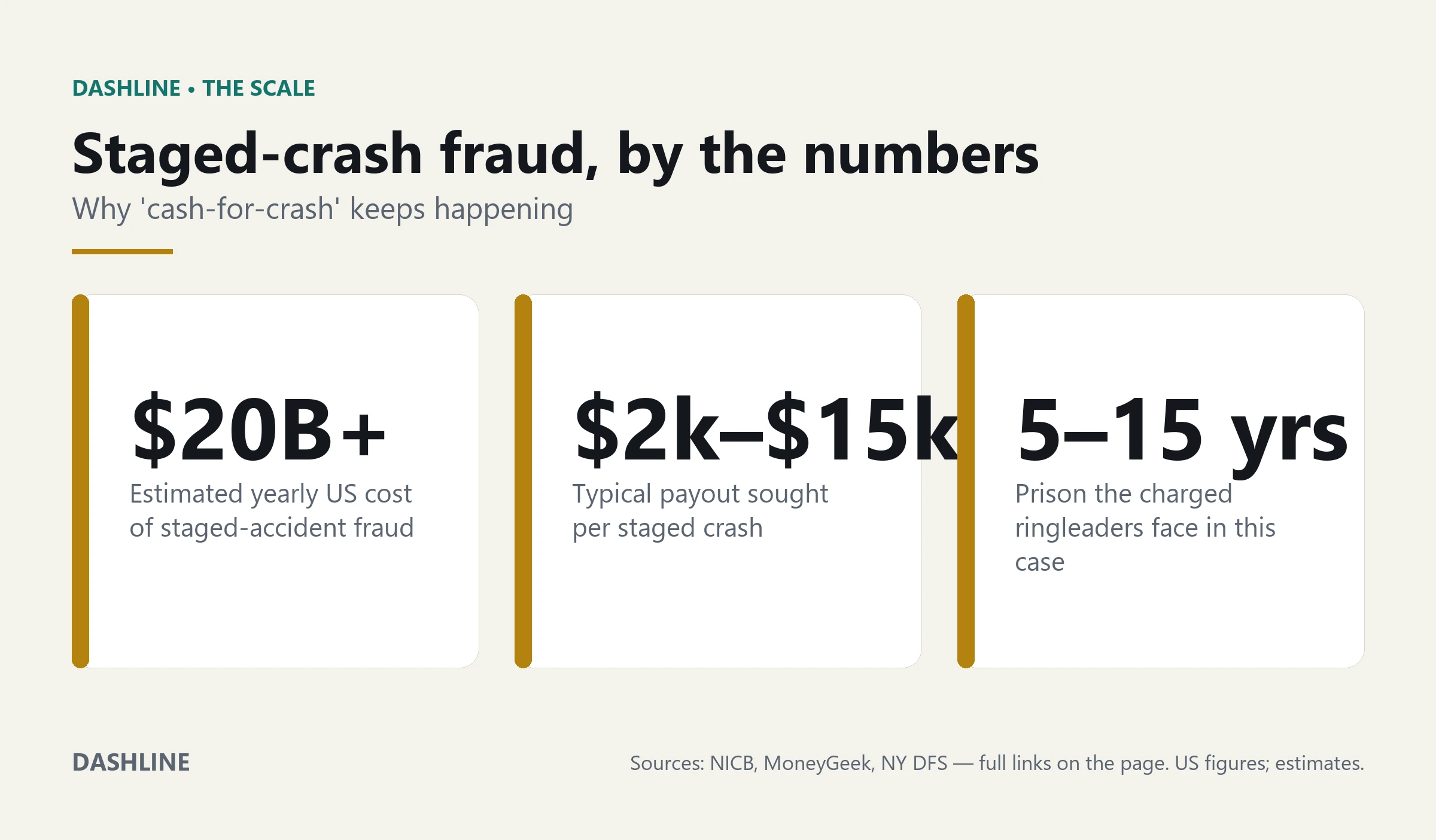
Staged-accident fraud is one of the costliest forms of insurance crime. The National Insurance Crime Bureau lists it among the most damaging white-collar crimes in the US, with industry estimates putting staged accidents at roughly $20 billion a year. Analysts at MoneyGeek put a typical single scam at $2,000–$15,000, and note that being caught up in one can push an average premium from about $1,623 to $2,363. Every fake claim is money that eventually shows up on honest drivers’ renewals. We keep the wider picture — US adoption, the insurance reality and the safety & fraud numbers, every figure sourced — in our dash cam statistics for 2026.
Evidence · why footage wins
How a dash cam turns the claim around
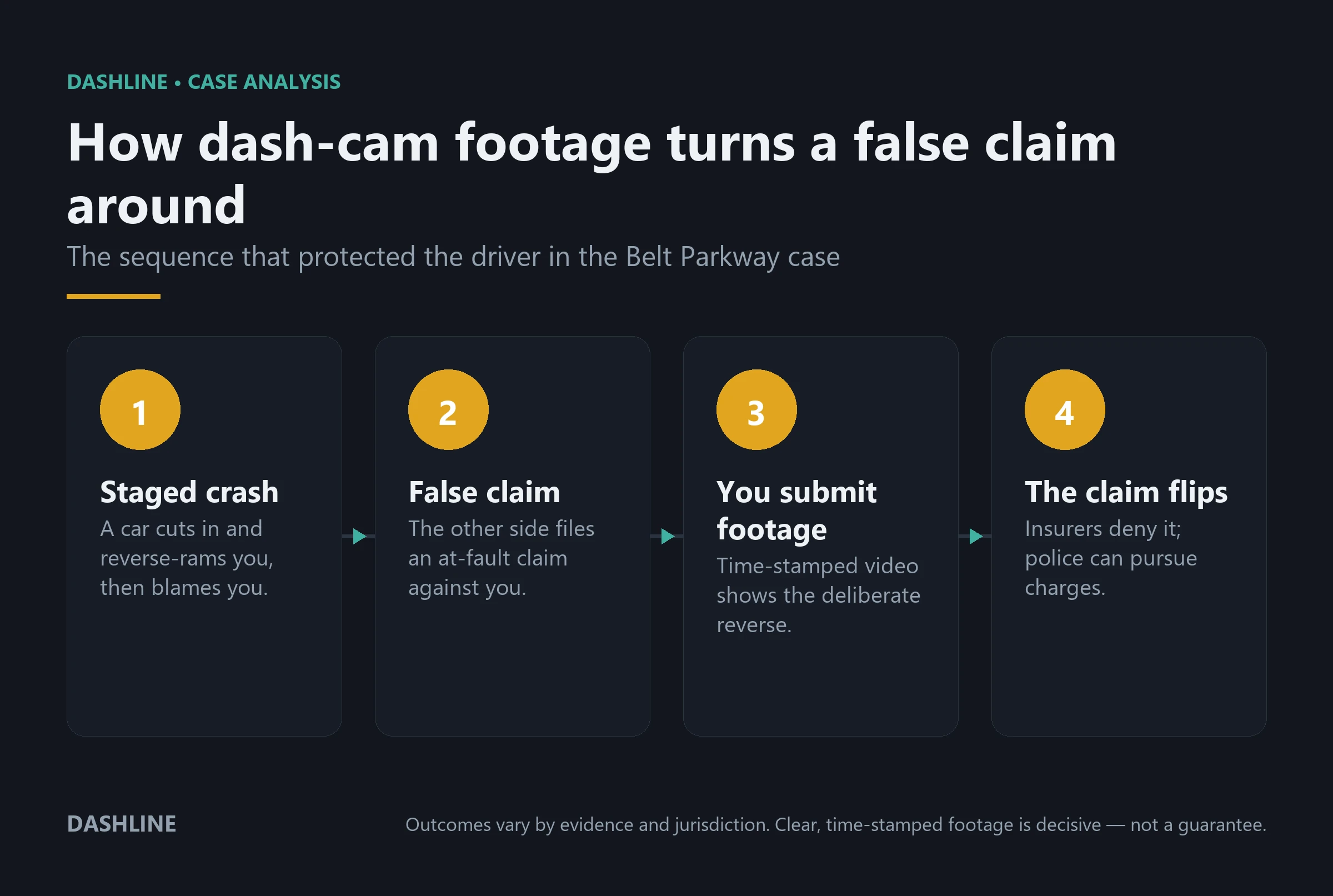
A written claim is a contest of statements. A time-stamped video is a record. That is the whole difference — and it is why an insurer can move from “disputed” to “denied” when clear footage lands on the file.
The four things that make footage hold up
Not every camera would have saved this driver. The features that turn a clip into evidence are specific — and worth understanding before you rely on one.
- Front & rear coverage. A reverse-ram or a rear shunt happens behind you; a rear camera is what actually records it.
- Loop recording with impact lock. A jolt auto-saves the clip so the loop can’t overwrite the one moment that matters.
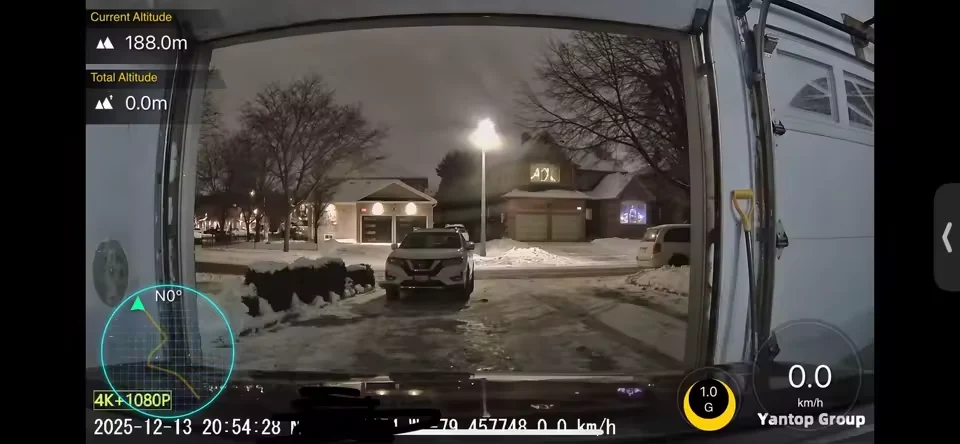
- GPS, speed and timestamp overlay. Location, speed and time on-frame answer the questions an adjuster asks first.
- Clear resolution in daylight. 4K in good light reads plates and lane positions — the details a dispute turns on.
Honest limits · what a camera can’t do
Where footage helps — and where it doesn’t
It records; it can’t prevent
A camera doesn’t stop a scammer reversing into you. It changes what happens after — who is believed, and who gets charged.
Clarity is conditional
Night, glare, speed and angle all affect what a plate or a face looks like on playback. Reading a plate in the dark is never guaranteed — here’s why.
It doesn’t auto-win the claim
Footage is powerful, but the outcome still depends on the insurer, the report and the law. It stacks the odds; it isn’t a guarantee. If you want to put a number on that — what avoiding one at-fault claim is actually worth over a policy’s life — our free dash cam insurance savings calculator works it through honestly.
You still have to keep the clip
Loop recording overwrites. If the file isn’t locked or saved, the evidence can be gone by the time you need it. Secure it fast.
Legal & insurance
What the charges — and your footage — actually mean
Staging a collision isn’t a grey area. In this case the charges reportedly include staging a motor-vehicle accident, insurance fraud, criminal mischief and reckless endangerment — because a deliberate crash on a live highway puts everyone nearby at risk, not just the target.
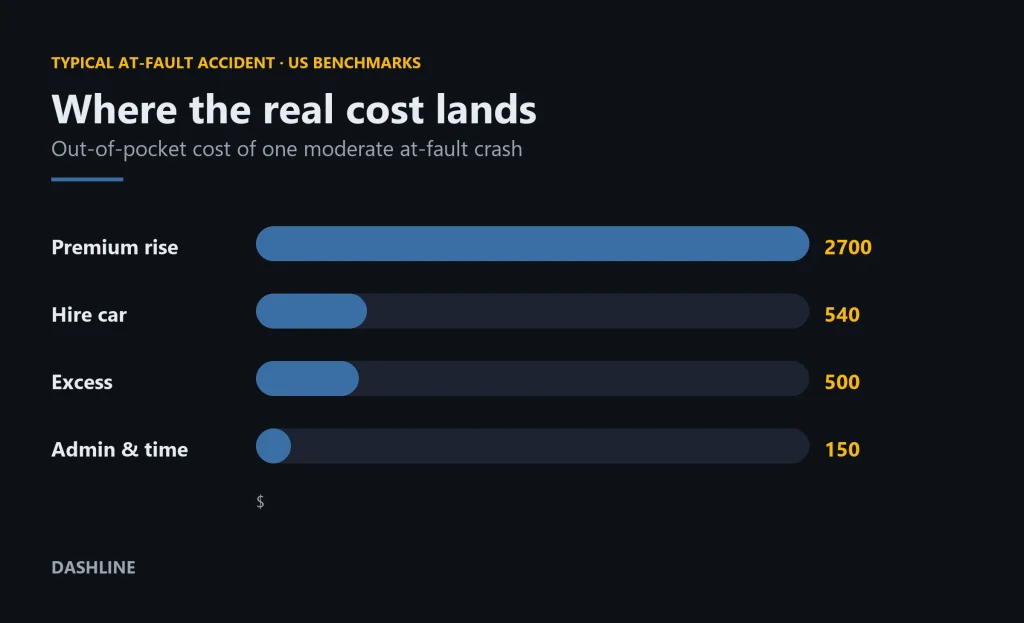
For an ordinary driver, the insurance stakes are quieter but real. Being wrongly blamed for an at-fault crash can cost you your excess and your no-claims discount, and push your renewal up for years. Clear footage is what protects those — it’s the difference between a claim recorded against you and one thrown out. For the bigger picture, see whether a dash cam actually lowers your insurance, and if you’re ever in a collision, what to do at the scene so the footage counts. Want to see what a real accident typically costs to fix versus write off? Try the free accident cost calculator.
Safety · if a crash feels staged
What to do if you suspect a set-up
Keep your distance
Space is your best defence against a brake-check. The more room you leave, the harder you are to target.
Don’t admit fault at the scene
Stay calm and factual. An apology in the moment can be read as an admission later.
Call the police and get a report
An official record matters — especially if injuries are suddenly claimed that don’t match the impact.
Document everyone and everything
Photograph the vehicles, plates and all occupants. Staged crashes often involve extra “passengers” and phantom injuries.
Save and lock the clip immediately
Protect the footage on the camera so loop recording can’t overwrite it, and back it up before you do anything else.
Report suspected fraud — but don’t post it
Give the video to police and your insurer. Publishing it publicly can raise privacy issues and complicate a live case.
FAQ
Staged crashes & dash cams, answered
What is a “cash-for-crash” or staged accident?
How did the dash cam help in this case?
Would a front camera alone have been enough?
Do insurers actually accept dash-cam footage?
Can footage read the other car’s number plate?
Should I post viral crash footage online?
Does a dash cam guarantee I’ll win a disputed claim?
The takeaway
The camera didn’t stop the crash. It settled it.
The Belt Parkway driver did nothing wrong — and walked away vindicated only because something was recording. In a comparable situation, the features that decide it are the ordinary ones: front-and-rear coverage, loop recording with impact lock, an on-frame timestamp, and clear 4K in daylight. That’s exactly what the Dashline 4K is built to do — €85.95, with a screen and memory card in the box.
View the Dashline 4K A camera is evidence, not a guarantee — but on a bad day, it’s the difference between a dispute and a record.
Leave a Reply