
Dashline Tools · Interactive
How Far Can a Dash Cam Read a License Plate?
A dash cam sees a car long before it can read the plate. This calculator estimates the real read distance for any camera — from its resolution, lens angle and the light — using the same pixel-density standard the CCTV industry uses.
Try the calculator ↓The calculator
Set your camera. See the read zone.
Adjust the four inputs. The distances update live, along with a top-down view of where a plate is confidently readable, where it is borderline, and where you only capture a vehicle.
Resolution
Horizontal field of view — 170°
Number plate
Light & conditions
Confident read
Borderline / fringe
At 4K, 170°, daylight, an EU plate is confidently readable to about 5 m — roughly one car length. These are clear-condition optical ceilings; real footage is often worse.
Three things worth quoting
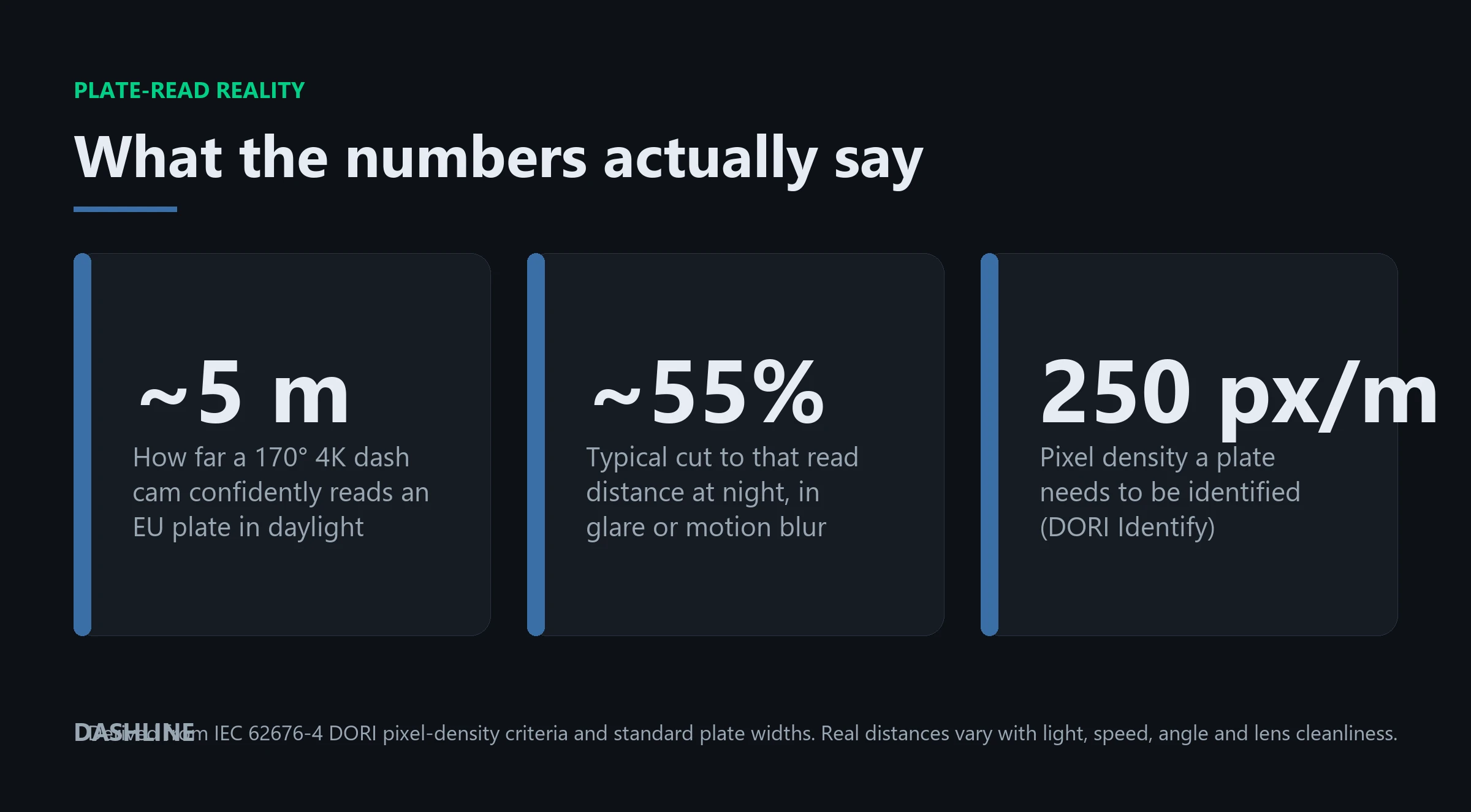
Distance a 170° 4K dash cam confidently reads an EU plate in daylight — about one car length.
Derived · DORI 250 px/mTypical reduction in that read distance at night, in glare or with motion blur.
Conservative condition factorPixel density a target needs before it can be identified, per the IEC 62676-4 “DORI” standard.
IEC 62676-4How the math works
No black box. Here is the whole formula.
Legibility comes down to how many pixels land across the plate. A lens spreads its pixels over its whole field of view, so a wider angle — or a farther car — puts fewer pixels on the plate. The geometry is simple:
→ read distance = ( horizontal pixels × plate width ) ÷ ( FOV rad × threshold ) × condition
threshold: ≥130 px across the plate = confident read · ≥65 px = borderline
( 130 px on a 0.52 m plate = 250 px/m — the DORI “Identify” level )
condition factor: daylight 1.0 · dusk 0.7 · night 0.45
- Plate widths use the real standards: EU/UK ≈ 520 mm, US ≈ 305 mm. A smaller plate needs to be closer.
- Thresholds are anchored to the IEC 62676-4 DORI pixel-density criteria (Identify 250 px/m, Recognise 125 px/m).
- The condition factor is a deliberately conservative allowance for exposure, headlight glare and motion blur — not a lab figure.
- It assumes a clean lens, a plate square-on to the camera, and native resolution. Interpolated “4K”, dirt, rain or an angled plate all read worse. See our field-of-view guide for how lens angle trades reach for coverage.
By resolution
What more pixels actually buy you
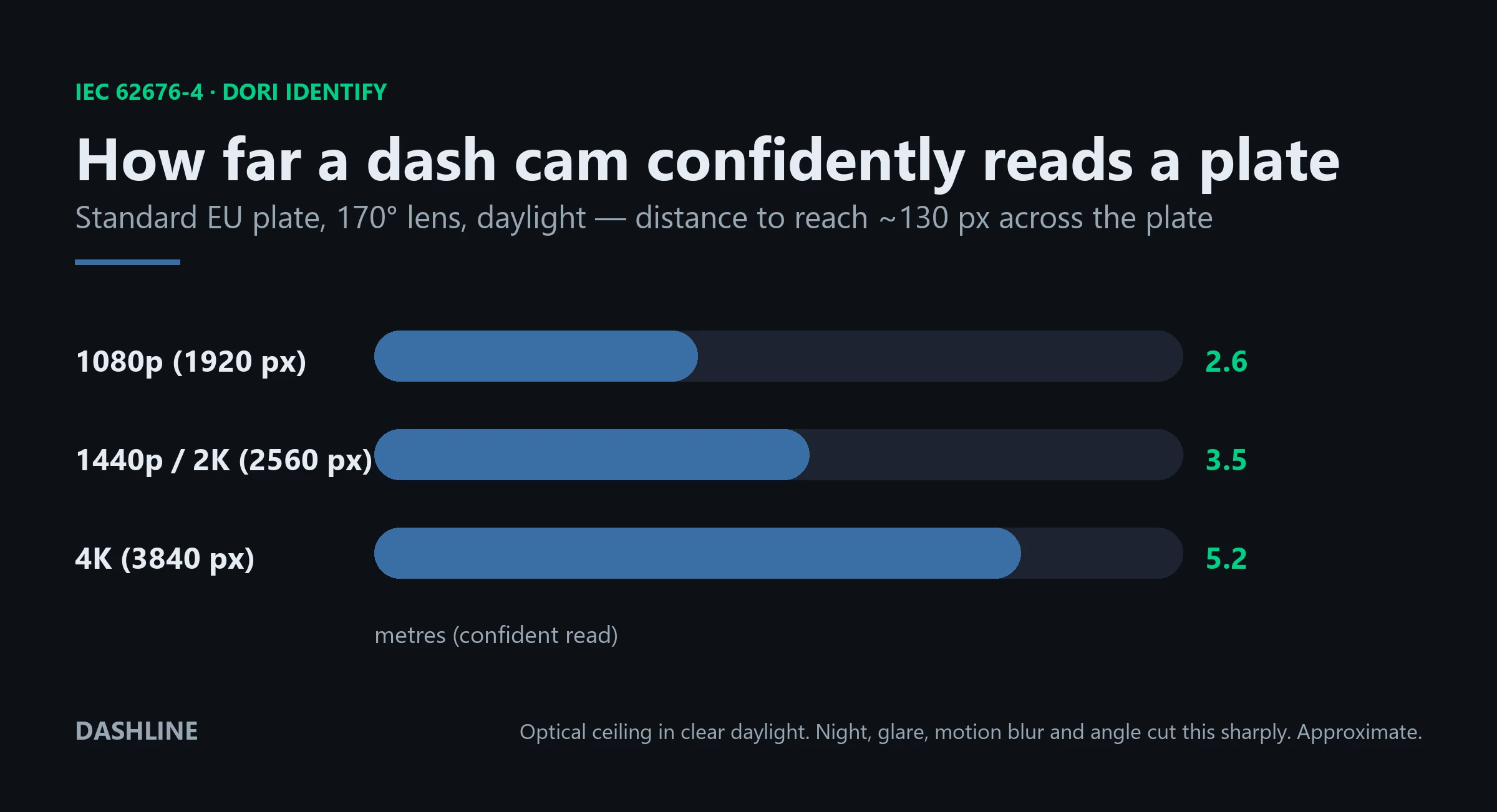
Going from 1080p to 4K roughly doubles the distance at which a plate stays legible — the single biggest lever, ahead of any “night vision” marketing.
The sourced numbers
Every figure behind the tool
| Quantity | Value used | Source |
|---|---|---|
| DORI “Identify” (confident read) | 250 px/m on target | Axis / IEC 62676-4 |
| DORI “Recognise” (fringe) | 125 px/m on target | Axis / IEC 62676-4 |
| Human plate legibility | ≈130 px across the plate | Plate Recognizer |
| ANPR design target | 100–150 px across the plate | Bosch Security |
| EU / UK plate width | 520 mm | Vehicle registration plate |
| US plate width | 305 mm (12 in) | Vehicle registration plate |
The honest part
Why real plates are unreadable more often than the math says
The distances above are best-case ceilings. Four things routinely make footage worse — which is exactly why we’d rather you know before you rely on it.
Night & headlight glare
After dark, plates are either lost in shadow or blown white by their own retroreflective glare under your headlights. Read distance often drops by half or more. We cover this in depth in reading plates at night.
Motion & closing speed
A plate sharp when parked can smear at speed. Two cars closing at 100 km/h cross several metres per frame — the exact frame you need can be the blurred one.
Angle & lane offset
The formula assumes a plate square-on. A car one or two lanes over, or turning, presents its plate at an angle — fewer usable pixels, and characters that foreshorten.
Dirt & interpolated “4K”
A grimy lens, road spray, or a sensor that upscales 1080p to “4K” all erase real detail. Native 4K matters; a bigger number on the box does not.
Cite this page
Dashline. “How Far Can a Dash Cam Read a License Plate? — Read-Distance Calculator.” dashlinecameras.com.
Figures derived from IEC 62676-4 (DORI) pixel-density criteria and standard plate dimensions. Free to reference with a link.
FAQ
Common questions
How far can a dash cam read a license plate?
In clear daylight, a 4K dash cam with a wide 170° lens can confidently read a standard EU plate to roughly 5 metres — about one car length ahead. A 1080p camera manages closer to 2.5 metres. At night or in glare those figures roughly halve. Beyond the “read” distance the camera still records the vehicle, just not the plate.
Why can’t my dash cam read plates that look close on screen?
A car can fill much of the frame while its plate is still only a few dozen pixels wide — below the ~130 pixels a human needs to read characters reliably. Speed, angle, a dirty lens and low light all reduce usable pixels further, so a plate that looks “right there” can still be illegible.
Does a higher resolution really help read plates?
Yes — it’s the biggest lever. Doubling horizontal resolution roughly doubles the distance at which a plate stays legible. Going 1080p → 4K is far more effective than any “super night vision” label, provided the 4K is native and not upscaled.
Does a wider lens angle reduce plate-reading distance?
It does. A wider field of view spreads the same pixels across more scene, so fewer land on any one plate. A 170° lens sees more of the road but reads plates at shorter range than a narrow lens at the same resolution — a genuine trade-off between coverage and reach.
Is this calculator accurate for my exact camera?
Treat it as a realistic planning estimate, not a guarantee. It uses the accepted DORI pixel-density thresholds and real plate sizes, but your lens quality, bitrate, compression, mounting angle and the weather all shift the real number. It’s built to be honest about the ceiling, not to flatter any camera.
What resolution do I need to read plates reliably?
For everyday evidence at normal following distances, native 4K gives the most margin. 1080p can work when the other car is close, well-lit and roughly square-on, but leaves little room for speed, angle or darkness. Whatever the resolution, keeping the lens clean and the exposure sane matters as much as the pixel count.
Built by Dashline
We build the 4K camera these numbers assume
The Dashline 4K runs a native 3840-pixel sensor behind a 170° lens — wide coverage, with the resolution to keep plates legible as far as the physics allows. No subscription, card included.
View the Dashline 4K
Leave a Reply